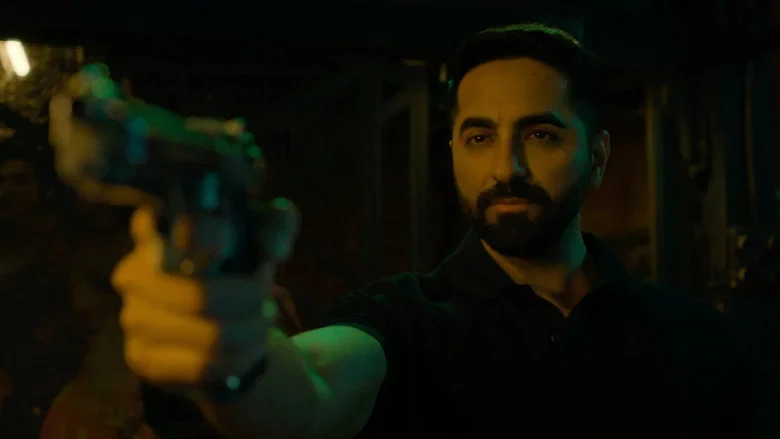


The screen goes dark on a prayer for power, and the man whispering it has a jaw set like a closing gate. Nitesh Tiwari’s Ramayana opens not with Ayodhya’s silk but with an Asura’s grievance.
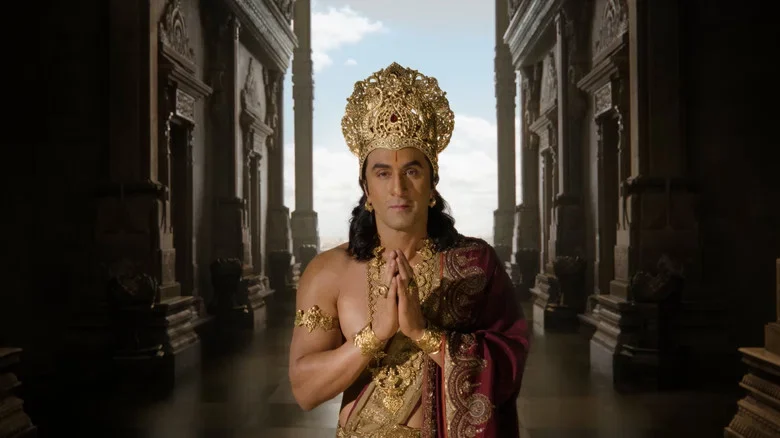
Yash Builds a Villain Out of Politics, Not Fangs
Ravana arrives as a liberator before he becomes a conqueror. The film hands him a clan in chains and a Lanka under Deva heel, and Yash plays the grievance with a low, level register that refuses to beg.
Watch his stillness during the early council scenes. He sits back while others lean forward, letting his siblings carry the noise, and the camera has to come to him.
That spatial confidence is the film’s finest instinct. When Ravana’s objective curdles from freedom into annihilation, Yash doesn’t crank the volume; he narrows his eyes and lets the sentence land unfinished.
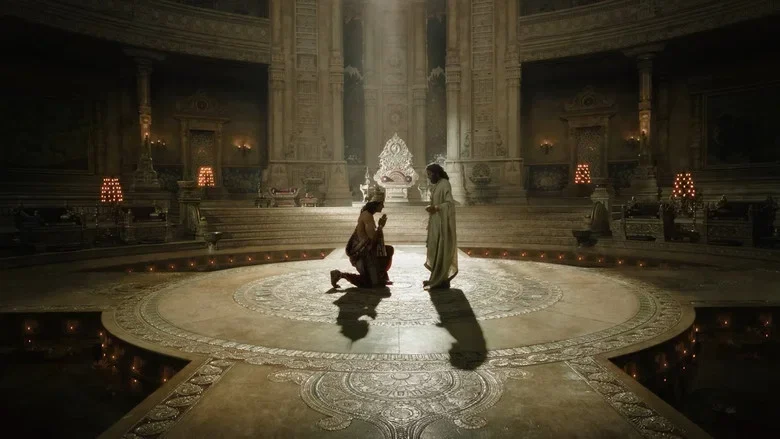
Ranbir Kapoor Plays Duty as a Cage, Not a Crown
Kapoor’s Rama is defined by what he withholds. He plays the prince as a man constantly measuring his own reactions, and the restraint reads as discipline rather than vacancy.
The marriage scenes with Sai Pallavi carry a quiet, formal courtesy that slowly warms. She answers his formality with a sideways glance and a half-smile, and the pairing earns its place in the middle stretch.
Where the performance thins is in the divine register. When the script asks Rama to carry Vishnu’s cosmic weight, Kapoor’s physical vocabulary stays stubbornly human, and the film never quite decides whether that’s the point.
A First Chapter That Refuses to Say It’s a First Chapter
The structural problem is packaging, not plotting. This is one half of a two-part adaptation, and the international title swaps an honest “Part One” for the vaguer “Rise of a Legend.”
That sleight of hand creates an expectation the film cannot satisfy. Audiences walk in braced for a complete Ramayana and leave with a handshake and a promise.
The first hour carries a heavy exposition load, threading cosmic balance, Asura politics, Ayodhya’s royal household, and a divine incarnation through the same corridor. Tiwari keeps the camera patient, but the screenplay is forever introducing.
By the time exile arrives, the film has finally found its emotional gear. Then it ends, and the theatre’s collective exhale is half anticipation and half irritation.
The CGI Is Ambitious and Occasionally Airless
Prime Focus and DNEG build a cosmological scale that genuinely dwarfs its characters. The Deva–Asura conflict reads as a war between weather systems, and that’s a compliment.
But the effects-led texture flattens the intimacy Tiwari is best at. Where a filmmaker like the one behind Dilwali Diwali lets domestic rooms do the dramatic work, this film keeps reaching for the skybox.
The Hans Zimmer and A.R. Rahman score is doing heavy lifting in the absence of verified song identity, swelling under every proclamation. It works, though it rarely surprises.
The quieter passages suffer most. A palace conversation shot in flat, even light has less charge than a single close-up of Yash’s jaw working through a decision.
Sai Pallavi Holds the Human Centre While the Epic Swells
Pallavi’s Sita is the film’s emotional anchor, and she plays the role with a composed directness that resists decorative piety.
Her best moment arrives in the exile transition, when she reads the room before anyone speaks. It’s a small, watchful gesture that gives the departure its weight.
The supporting gallery is largely functional. Arun Govil’s Dashrath carries the royal gravity the role demands, and Lara Dutta’s Kaikeyi registers the palace intrigue without much room to complicate it.
Sunny Deol’s Hanuman is positioned for the sequel, and the film treats him accordingly: present, potent, withheld.
What the ensemble lacks is the kind of sister-performance ferocity Yash brought to Toxic. Here he’s the only actor allowed to chew the frame, and the imbalance shows.
The Romantic Register Is the Film’s Most Underrated Asset
Strip away the cosmology and the marriage is the most convincing thing on screen. The film treats Rama and Sita’s union as a negotiation of duty between two careful people, and that’s more interesting than any battle.
It’s a more disciplined romantic construction than the one attempted in Love Story Abhimanyu Ki, where the triangle never found its pulse.
Where this film stumbles is in trusting that intimacy enough. Every time the marriage earns a moment, the film cuts to a skyline or a prophecy.
What Nitesh Tiwari Gains and Loses at This Scale
Tiwari’s gift has always been family pressure rendered as physical behaviour. Here he applies that instinct to a dynasty, and the palace scenes crackle when they slow down.
The problem is that mythological fantasy demands a different rhythm, and the film keeps defaulting to proclamation. Characters announce their destinies rather than discovering them.
Still, the Ravana origin stretch shows what a more patient mythological drama could look like. It’s the one section where the film’s ideas and its images are pulling in the same direction.
Prime Focus, DNEG, and a ₹4, 000 Crore Bet
This is the most expensive bet in the history of Indian mythological cinema, with Namit Malhotra’s Prime Focus Studios and DNEG co-producing alongside Yash’s Monster Mind Creations.
The reported combined budget for both parts sits near ₹4, 000 crore, which means the first instalment must not only perform but build a sequel’s worth of goodwill.
That’s a brutal position for a film that withholds its climax. The theatrical marketplace rewards closure, and this film deliberately doesn’t offer it.
Kapoor’s box-office leverage is real, but it’s untested in this register. He’s asking audiences to accept him as a divine prince, and the film’s marketing has leaned on spectacle rather than that leap of faith.
The two-part gamble also arrives in a market where audiences are increasingly allergic to being sold an unfinished story. The industry’s appetite for contemporary Hindi fantasys is genuine, but so is its impatience.
The Verdict: A Grand Opening That Forgets to Close
Ramayana: Rise of a Legend is a genuinely ambitious piece of filmmaking that mistakes setup for story. Yash’s Ravana is the reason to buy a ticket, and Kapoor’s restraint is the reason to keep watching him.
But a film that ends on a promise is asking for trust it hasn’t yet earned. The sequel will have to deliver the war this one keeps postponing.
For now, the legend rises. Whether it lands is a question for next Diwali.
Ankit Jaiswal is the Chief Author, covering Indian cinema and OTT releases with honest, no-filler criticism. An SEO strategist by background, he brings a research-driven approach to film writing, cutting through hype to tell you exactly what's worth your time.