

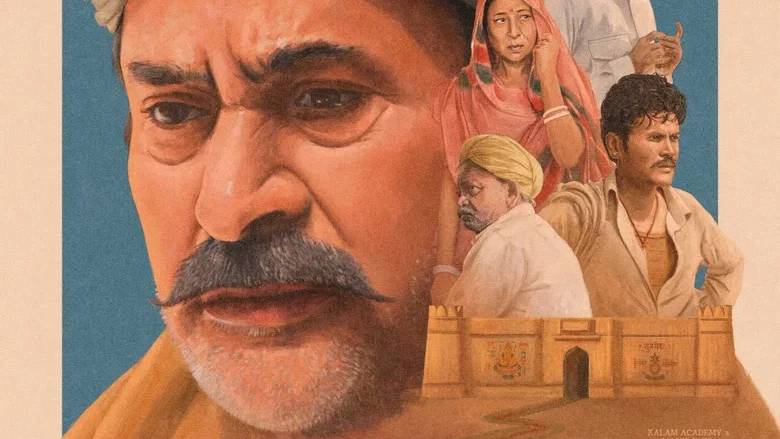
An isolated homestead in the early-1990s Thar, a family slowly poisoning itself over inheritance, and Yashpal Sharma sitting at the centre of it all with the stillness of a man who has already decided something terrible.
Anand Singh Chouhan’s Rajasthani-language chamber thriller is aiming for a pan-India theatrical footprint, and it earns its ambition through atmosphere before it earns it through plot.
When Lineage Becomes a Weapon, the Desert Stops Being Scenery
Chouhan opens on the household rather than the landscape, which is the correct instinct. The dunes outside are not postcard material; they are a moat.
Every conversation in the first stretch carries the low hum of an audit, who is owed what, who will inherit the name, who has been quietly written out of the ledger. The film’s desert isolation functions as a structural trap rather than a visual flourish, sealing the family off from any outside arbitration.
It is a discipline of restraint that recalls the tighter spatial control on display in Pehla Pyaar Doosri Baar, where confined rooms did the heavy lifting that dialogue could not.
The Countdown Is Internal, and That Is Both the Film’s Engine and Its Risk
What Chouhan constructs in the middle stretch is less a whodunit than a how-long-until-something-breaks. Greed and authority are treated as a single organism, passed around the table like a serving dish nobody wants to touch first.
The screenplay’s smartest move is refusing to nominate a single villain. There is no external antagonist to absorb the blame, which means every family member is implicated in the slow corrosion of the household.
The risk is real: a domestic countdown with no visible clock demands that the performances carry the escalation, and when the writing leans on atmosphere instead of incident, the middle act can feel like a held breath with no release date.
Sharma’s Stillness, Amin’s Silence, and the Rooms Between Them
Sharma plays his patriarch with a flat, level voice and hands that never quite settle, a man who speaks softly because he knows the room will lean in to listen. Watch how he occupies doorways rather than chairs, always half-in and half-out of the conversation.
It is a performance built on withheld information rather than announced menace, and it sits comfortably alongside the quiet, physically grounded work he has done before. The same instinct for understatement that anchored the sincere, conventional body-reclamation drama of Sumo Didi is visible here, though Dhood gives it a crueller frame.
Alka Amin, meanwhile, does her finest work in the negative space, a pause before answering, a hand withdrawn from a table, a glance that lands a beat too late. The film’s most charged sequences are not arguments but the silences immediately after them.
The debuting ensemble around them is harder to assess; several are given presence without function, positioned in rooms to observe rather than to act. That is a structural weakness, not a performance one.
Desert Light, Period Texture, and a Score That Knows When to Shut Up
Chouhan and his team shoot the household in hard, unflattering daylight, keeping the camera at middle distance so that faces are always partially in shadow. It is a choice that refuses the comfort of a clean close-up.
The early-1990s period detail is deployed with restraint, the texture of the clothing, the absence of modern intrusion, the way the house itself looks older than the decade it sits in.
Mehul Surti’s score is at its best when it recedes entirely, letting the creak of a door or the wind against stone do the work. When the music does arrive, it occasionally overstates what the frame has already communicated.
The film’s psychological-thriller mechanics share DNA with the cross-decade obsession at the heart of Tu Hai Meri Kiran, though Dhood trades that film’s romantic fixation for the colder arithmetic of inheritance and control.
What a Pan-India Release Means for Rajasthani Cinema’s Bottom Line
The commercial stakes here are worth naming plainly. This is a Rajasthani-language film presented by Kalam Academy and Samar Jain, produced through Soul of Desert Production with Ainak Co-Labs, and its pan-India theatrical plan is the real story.
A regional-language chamber thriller with no established franchise and no conventional star-vehicle architecture is a gamble. The upside is that the audience for contained, culturally specific suspense has been quietly growing across contemporary hindi thrillers, and Dhood is positioned to catch that current.
The downside is distribution math: a limited-screen release with a slow-building first half will live or die on word of mouth from its opening weekend, not on marketing spend.
The Final Reckoning and the Cost of Preserving a Name
What Chouhan leaves you with is not a twist but a diagnosis. The film’s closing movement settles into the recognition that legacy, once treated as a possession, stops being a bond and becomes a cage.
Dhood is a patient, physically specific, occasionally underpowered piece of regional filmmaking that understands its setting better than its plot. It is worth the ticket for Sharma’s withheld performance and for the sight of a Rajasthani story refusing to apologise for its own language.
And it leaves one image behind that is hard to shake: a family sitting in the same room, in the same light, each one already somewhere else.
Ankit Jaiswal is the Chief Author, covering Indian cinema and OTT releases with honest, no-filler criticism. An SEO strategist by background, he brings a research-driven approach to film writing, cutting through hype to tell you exactly what's worth your time.