

The first sound is flesh hitting flesh in a Taiwanese ring, and the crowd noise arrives a half-second late, as if stunned by its own applause. Hetal Dave has already won before we are told who she is.
That flash-forward is the most confident decision Sumo Didi makes. The remaining hundred-odd minutes spend themselves earning it back.

Jayant Rohatgi Opens With the Destination and Then Walks Backward
The victory in Taiwan functions as a structural promise. Then the film jumps nine months earlier into a Marwari household where the kitchen is a courtroom and Hetal’s body is the defendant.
Her mother Sudha presses bitter-gourd juice into her hands with the tenderness of someone administering medicine. Yoga follows. Liposuction is raised, not as a threat, but as a reasonable family suggestion.
Rohatgi’s smartest instinct is refusing to build a single villain out of this. The pressure is distributed across relatives, neighbours, marriage brokers and the ambient shame of a community that treats a daughter’s weight as a public debt.
Where the direction loses nerve is in escalation. Each confrontation lands on the same beat, weight, marriage, respectability, so the second act begins to feel like the same argument restaged with different crockery.
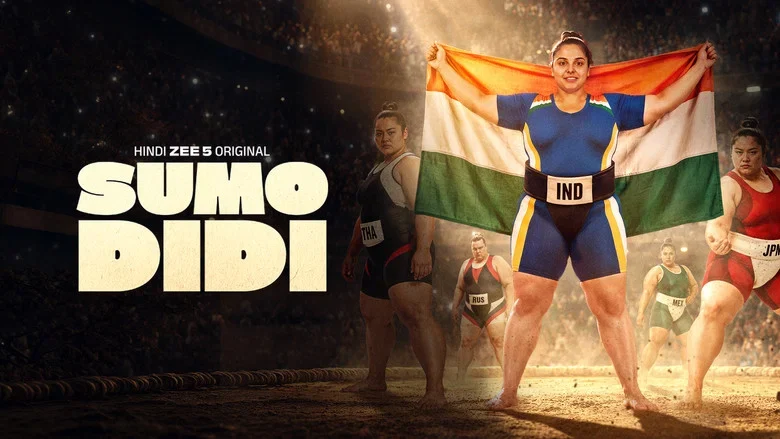
Shriyam Bhagnani Plays Accumulated Irritation Rather Than Simple Defiance
Watch her in the domestic scenes. She does not shout back at Sudha. She absorbs, jaw tightening, eyes fixed on a middle distance just past her mother’s shoulder, and the anger pools rather than spills.
That restraint pays off later. The childhood sequence in which Hetal strikes a neighbour after being mocked establishes a reactive temper, and the judo training that follows converts that temper into controlled aggression without ever fully erasing it.
Inside the ring, the performance changes register entirely. Bhagnani drops her shoulders, widens her base, and moves with a heaviness that reads as technique rather than weight, a distinction the film depends on and mostly earns.
Her work here shares a certain stubborn interiority with the central turn in Udta Teer, where a performer must hold a character together while the material around them wobbles.
Anubha Fatehpura Makes the Mother a Source of Cost, Not Cartoon
Sudha could have been written as an obstacle to be defeated. Fatehpura instead plays her as a woman genuinely terrified of what the world will do to a daughter who refuses to shrink.
Her disapproval has a texture, the way she sets down a plate, the flatness in her voice when she mentions marriage prospects, that gives the sumo decision an emotional price inside the home rather than only in the arena.
Nitesh Pandey’s Rajendra is the quieter counterweight, redirecting his daughter’s aggression into judo instead of punishing it. It is a small pivot that the entire plot hangs on, and he plays it with the weariness of a man choosing the lesser of two anxieties.
Chaitanya Sharma’s Akshat, the physiotherapist and closest ally, does the practical labour of pulling Hetal out of her low phases. He is functional rather than vivid, and the screenplay never quite decides whether he is a character or a device.
The Body That Was a Liability Becomes the Instrument of Force
This is the film’s real thesis, and it is a good one. Outside the ring, Hetal is evaluated for appearance. Inside it, mass, balance and leverage become competitive assets that no one can shame away.
The cinematography leans on that contrast, cramped, warm-toned interiors against the colder, wider geometry of training halls and international competition floors. It is a legible visual argument, though not a subtle one.
What the film underdevelops is the machinery of the sport itself. Money, access, coaching infrastructure and the sheer bureaucratic absurdity of pursuing women’s sumo in India are named as obstacles but rarely dramatised with the specificity granted to the dinner-table body policing.
The screenplay resists the kinetic sensationalism that overtook Poniiy, opting instead for a patient domestic register. That patience is a virtue in the first hour and a limitation in the second.
Japan and Taiwan Enlarge the World but Not the Drama
The international sections give the film geographic progression, from local ridicule to foreign recognition, and the Japan training sequences carry a genuine sense of unfamiliar discipline.
Yet the stakes do not rise proportionally. The competition in the final act is staged competently, but the film has spent so much energy on the mother’s objections that the sporting climax feels like a formality rather than a reckoning.
The editing is tighter in the first half, where the chain from humiliation to judo to sumo is clear and motivated. The second half expands the canvas and, in doing so, thins the emotional pressure.
This is a recurring tension across contemporary Hindi dramas that mistake geographic expansion for dramatic escalation. Distance from home is not automatically depth of feeling.
ZEE5 Gets a Prestige Sports Biopic at a Modest Price
The film arrives as a ZEE5 original rather than a theatrical proposition, which reframes the commercial question entirely. There is no opening-day net to parse, no first-week trajectory to defend.
Its listed production and P&A outlay sits around ₹1.25 crore, a figure that makes sense for a streaming play built on a first-time lead and a sport with almost no domestic footprint.
For the platform, the value is in the library, a women-led underdog story with a body-positivity hook and an Olympic-adjacent curiosity factor. For Bhagnani, it is a calling card, and a physically committed one.
What it is not is a franchise starter. The sports-biopic pipeline in Hindi cinema remains crowded and increasingly formulaic, as the structural drift in Tu Hai Meri Kiran suggests; novelty of subject is no longer enough on its own.
The Ending Refuses to Make Marriage the Measure of a Life
The resolution is deliberately double, athletic and domestic. Hetal wins recognition in the ring, but the quieter victory is her refusal to treat marriageability as the finish line.
That is a meaningful thing for a Hindi film to say, and it says it without a speech. The final image of her body as an instrument of force rather than a problem to be corrected lands because the film has spent two hours earning the reversal.
What lingers, though, is the sense of a story that was stranger and harder than the film allowed itself to be. Hetal Dave’s actual path through a sport with no Indian infrastructure for women is a more radical narrative than the one assembled here.
Sumo Didi is sincere, well-performed and structurally safe, a film that trusts its lead far more than it trusts its own material. Bhagnani is the reason to watch it. The screenplay is the reason you will remember the performance and not the plot.
Ankit Jaiswal is the Chief Author, covering Indian cinema and OTT releases with honest, no-filler criticism. An SEO strategist by background, he brings a research-driven approach to film writing, cutting through hype to tell you exactly what's worth your time.