

Ankit Bhadana opens his film on a Delhi rooftop at dusk, two lovers framed against a water tank, and the camera holds them there a beat too long, as if waiting for a feeling the script never supplies.
What follows is a two-hour negotiation between first love and arranged marriage that mistakes volume for depth.

A Love Triangle With No Third Corner
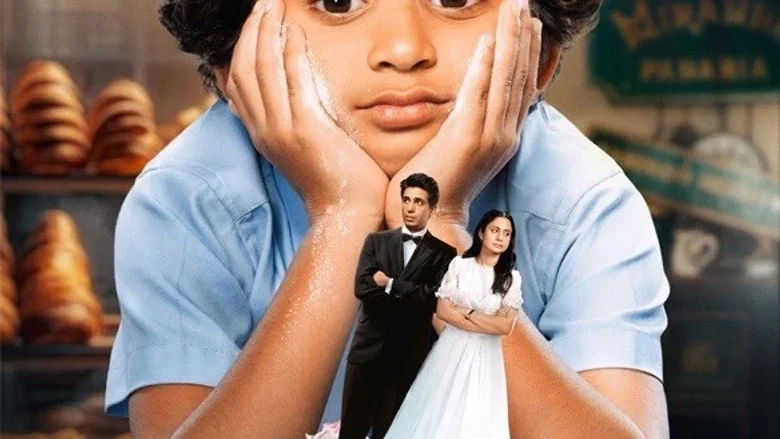
The premise is legible enough: Simple Yadav, played by Pragati Tiwari, is torn between Wasim Akhtar, her first love, and Abhimanyu Yadav, the man her family has selected.
But the film never gives Abhimanyu a real presence. Bhadana plays him with a mild, agreeable stillness, and the screenplay treats him as a plot device rather than a rival.
The result is a triangle with one missing side, and Simple’s agonizing has no weight because the alternative she rejects never feels like a genuine threat.

Dialogue That Recites Its Own Themes
Ayaskaant Tomar’s screenplay keeps having characters announce what the film is about. “You have to stand up for what you feel, ” Wasim says, and the line lands with the thud of a moral written on a blackboard.
There is not even a hint of novelty in the drama, and the dialogue stays routine throughout, so the emotional beats arrive pre-chewed rather than earned.
The film wants to connect romance to personal trauma and community pressure, but it does so by stating the connection rather than dramatizing it.
Pragati Tiwari’s Divided Woman Stays on the Surface
Tiwari has the film’s heaviest burden: a woman carrying trauma, family expectation, and a love she cannot publicly claim. Her face in the marriage-negotiation scenes is composed, but the composure reads as blankness rather than suppression.
When she finally breaks, the tears come on cue, but the build has not been laid, so the release feels like a performance of grief rather than grief itself.
The role needed an interior life the direction never grants her. Compare the quiet, accumulating sorrow Vinod Kapri builds in Pyre, where silence does the work the dialogue refuses to do.
Wasim as the Devoted Lover, Minus the Friction
Vishal Mohan plays Wasim as persistent and sacrificial, which is the correct note, but he plays only that note. His devotion is unwavering from the first scene, so there is no arc, only a position.
When he says he will not give up, the line has no cost attached, because the film never shows him genuinely tempted to walk away.
Bhadana’s own performance as Abhimanyu is passable but inert, and the supporting ensemble of relatives and elders functions as a chorus of disapproval rather than as individuals with stakes.
Delhi as Backdrop, Not as Pressure
The film was shot across Delhi, but the city never presses on the characters. The streets are clean, the light is even, and the camera stays at a polite middle distance that keeps us observers rather than participants.
Music by Vishnu Narayan and Pragati Music is functional, cueing emotion the images have not earned.
Where a film like Doosra uses formal restlessness to mirror its characters’ dislocation, this one settles for coverage, and the flatness becomes the film’s defining texture.
The Title Change and the Community It Could Not Hold
The film was originally titled Yadav Ji Ki Love Story and renamed after concerns about hurt feelings within the Yadav community, which is a telling detail: the movie wants to speak about community pressure but flinches from naming it directly.
That retreat mirrors the larger problem. The social conflict is invoked, then softened into background noise, so the film’s central question of a woman’s romantic agency never acquires real danger.
Compare the comparative peer Jhaad Phoonk, which at least commits to its own strange premise rather than diluting it for comfort.
The Box Office Math of a Non-Starter
Om Thakuraani Production released this with minimal publicity, and the numbers reflect it: an opening-day India net of roughly ₹0.05 crore with under two thousand tickets sold in advance.
For a small-banner romantic drama, that is not a slow start but a closed door. The A certificate further narrows the family audience the marketing seemed to court.
The film arrives in a market where contemporary Hindi dramas live or die on word of mouth, and with no star leverage and no critical support, there is no mouth to spread the word.
The Verdict: A Romance That Forgets to Fall in Love
Love Story Abhimanyu Ki ends with Simple making her choice, and the film treats that choice as a triumph, but the triumph is hollow because the film never made us feel what she was choosing between.
It is a romance that forgets to fall in love, a social drama that avoids the social, and a showcase for a lead actress the material never lets breathe.
Bhadana has made a film about standing up for your feelings that never stands for anything itself, and that is the quietest, saddest failure a love story can commit.
Ankit Jaiswal is the Chief Author, covering Indian cinema and OTT releases with honest, no-filler criticism. An SEO strategist by background, he brings a research-driven approach to film writing, cutting through hype to tell you exactly what's worth your time.