

The circus tent glows against Goa’s decaying coastline, and Kiara Advani’s Nadia swings into frame, a moment of grace in a world built on smuggled gold and broken loyalties. It’s the film’s most lyrical image, and it arrives early enough to promise something the 194-minute runtime can’t sustain.
Geetu Mohandas stages this period gangster drama with genuine ambition, layering colonial transition, criminal hierarchy, and family rot into a single frame. But ambition without discipline produces a film that feels both overstuffed and undercooked.

Yash’s Dual Role Demands More Than Star Power Can Deliver
Yash plays Raya, the power-hungry gangster, and Ticket, the son who inherits his violence. The physical transformation is there, the swagger, the hardened jaw, the controlled rage. His shift from commanding underworld boss to guilt-marked father in the later stretches shows real range.
But the dual-role device asks him to carry a confrontation that the screenplay hasn’t earned. The final standoff between father and son is the film’s most discussed scene, and it works in isolation. The problem is getting there, the emotional runway is cluttered with subplots that dilute rather than deepen the central wound.

The Gangster Machinery Runs on Repetition, Not Rhythm
The genre mechanics are familiar: territorial wars, shifting alliances, violence as a language of escalation. Goa’s political instability provides texture, and Mohandas shoots the coastal underworld with a decaying, post-colonial haze that feels lived-in. The gang-war stretch tracking Raya’s rise has genuine momentum.
But the film’s understanding of gangster drama is cumulative rather than surgical. Every conflict is louder than the last, every betrayal more theatrical, until violence stops meaning anything. The high-decibel stretches were the most criticised element in early reviews, and it’s easy to see why, excess becomes the default register instead of a chosen one.
The circus imagery offers the film’s sharpest contrast, placing performance against brutality, public spectacle against private damage. It’s a smart visual idea that Mohandas returns to too rarely. The sexualized sequences and repetitive bloodshed feel like concessions to a mass audience the art-film framing keeps pushing away.
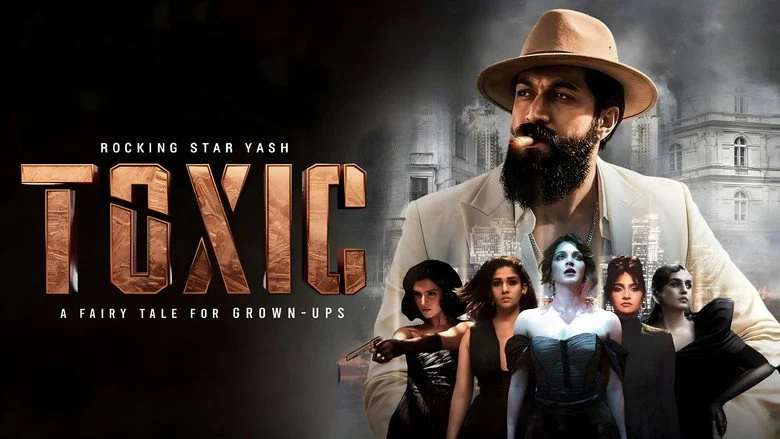
Nayanthara, Kiara Advani, and the Women Left in the Margins
Nayanthara’s Ganga is positioned inside the family-crime structure as Raya’s elder sister, and her presence signals the film’s intent to treat domestic bonds as criminal currency. She anchors the underworld power dynamic without ever getting a subplot of her own, a wasted resource in a cast this deep.
Kiara Advani’s Nadia carries the romantic axis, and her circus connection gives the film its one genuinely original performance space. Tara Sutaria’s Rebecca is tied to Raya’s alliance-building, more escalation than character. All three actresses are underserved by a screenplay that keeps promising them weight and then pulling focus back to Yash.
For a film called “A Fairy Tale for Grown-Ups, ” the women are treated like props in someone else’s story. That’s not just a political complaint, it’s a structural one. The narrative loses texture every time it sidelines the actors who could have given it dimension.
The Box Office Numbers Tell a Story the Critics Don’t
Times of India reported India net of Rs 54.85 crore by 3 PM on Day 1, with worldwide gross at Rs 64.72 crore, live figures subject to revision. Moneycontrol noted the film was eyeing a Rs 100 crore worldwide opening, and Pan-Asia Biz projected Rs 80–100 crore India net and Rs 100–120 crore worldwide.
Those numbers are enormous, and they reflect Yash’s pull rather than critical consensus. The audience praise points, Yash’s screen presence, the production scale, the climactic confrontation, are exactly what the criticism targets. This is a film that will make money while reviewers argue about whether it’s any good.
I keep returning to the gap between what this film wants to be and what it settles for. The ambition is real, but the execution keeps defaulting to the safest mass-action gestures. That’s not a compromise, it’s a confusion of intent.
Browse more Kannada Drama reviews for films that balance spectacle with craft.
A Father-Son Reckoning Buried Under Three Hours of Noise
The final confrontation between Raya and Ticket is the film’s best sequence, tight, angry, and emotionally legible in a way the preceding 170 minutes rarely achieve. It turns the gangster plot into family tragedy, which is exactly what the premise promised.
But getting there requires enduring tonal whiplash, repetitive violence, and a runtime that feels like a dare. The first half is setup-heavy world-building; the second half accelerates into confrontation but still drags. Shorter, sharper, and less indulgent, this could have been a statement. Instead, it’s a spectacle.
If you’re a Yash fan, you’ll find what you came for. If you’re looking for disciplined storytelling, prepare to wait until the last half hour. Watch it on the biggest screen you can find, but don’t expect the fairy tale, expect the grown-up parts, in all their messy excess.
For a tighter take on fractured father-son dynamics, Beyond Ratings review offers a leaner alternative.
Toxic is an overlong, uneven spectacle that its own ambition keeps strangling, 2.5 out of 5, and worth seeing only for the finale.
If you prefer your gangster tensions coiled rather than sprawling, TOY GUN verdict keeps the pressure on without the bloat.
Ankit Jaiswal is the Chief Author, covering Indian cinema and OTT releases with honest, no-filler criticism. An SEO strategist by background, he brings a research-driven approach to film writing, cutting through hype to tell you exactly what's worth your time.