

A phone rings in 2026. Somewhere in 2016, a lonely young man picks up, and Karan Rawal’s second feature begins its slow, uneasy slide from romance into surveillance.
A High-Concept Hook That Arrives With Its Own Expiration Date
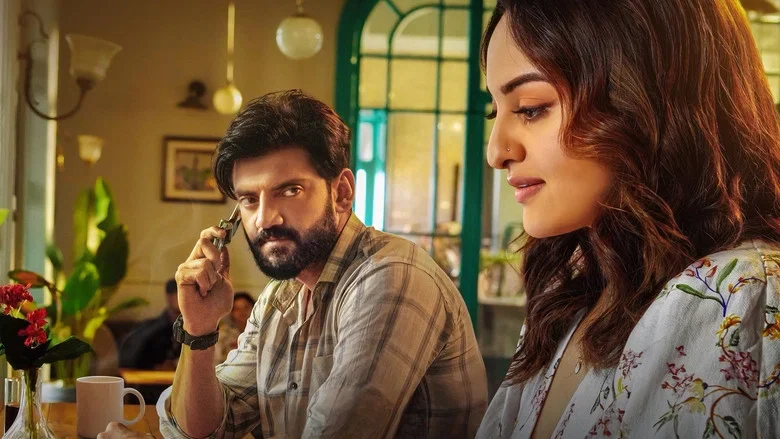
Rawal’s premise is genuinely seductive: bestselling author Kiran (Sonakshi Sinha) shares an inexplicable line to Samar (Zaheer Iqbal), a socially isolated man a decade behind her in time. The device is elegant, intimacy without proximity, a stranger who knows too much because he’s living in her past.
For roughly thirty minutes, the film trades on that elegance. The calls carry the charged hush of two people discovering each other across an impossible distance, and the screenplay lets the mystery of how linger longer than the mystery of who.
Then Samar hears the word “no, ” and the film’s real machinery kicks in. What follows is stalking, interference, and the slow weaponization of a temporal loophole, a premise that should be terrifying and, in fits, is.
When Affection Curdles, the Romantic Framing Refuses to Follow
Here is where Tu Hai Meri Kiran gets genuinely uncomfortable, not in the way it intends, but in the way that matters. The film wants to keep one foot in swooning romance even as Samar’s behavior becomes explicitly coercive, and that tonal split never resolves.
Rawal stages Samar’s escalation with real discipline: the calls grow more frequent, the questions more invasive, the entitlement more naked. But the score and the soft-focus intimacy of certain sequences keep whispering that this is still a love story, and the dissonance curdles.
The comparison to Drishyam is instructive, if unflattering. Where that thriller understood that a family’s survival instinct is the engine, this one can’t decide whether its engine is Kiran’s fear or Samar’s longing, and so it idles between them.
There is a version of this film that interrogates the romance of obsession head-on. Rawal’s screenplay keeps flinching from its own most interesting question.
Sinha Holds the Frame; Iqbal Hasn’t Yet Found the Man Beneath the Menace
Sinha is the film’s steadying force. Watch her in the early calls: she sits very still, phone pressed close, and lets curiosity and caution share the same expression, a small, precise piece of acting that keeps Kiran from becoming a victim archetype.
Her later scenes trade that stillness for something harder. When Kiran begins piecing together what Samar has altered, Sinha plays the detective and the target simultaneously, her jaw tightening before her voice does.
It’s the kind of controlled physical work that recalls the wounded resolve she carried through System, though here the material gives her less room to land it.
Iqbal has the harder job and the thinner map. Samar is written as a collection of behaviors, the hovering, the pleading, the sudden flat-voiced demands, and Iqbal plays the switches cleanly enough, but he never locates the wound underneath.
The character is a mechanism, not a person, which makes him scary in bursts and hollow in between.
The supporting ensemble, including Zarina Wahab, registers mostly as texture; the film gives them little to do beyond occupying Kiran’s world so Samar can violate it.
Rawal’s Cross-Cutting Ambition Outruns His Control
The director’s structural gamble is real: intercutting Kiran’s unraveling present with Samar’s formative past, letting the audience watch causality get rewritten in real time. Utkarsh Marulkar’s camera does distinguish the two eras, the 2016 passages sit in warmer, dustier light, the 2026 scenes in cooler, flatter tones, and that visual grammar is the film’s most confident gesture.
But the editing loses its footing in the back half. As Samar’s manipulations compound, the film has to explain its own time mechanics repeatedly, and each explanation drains tension rather than building it.
By the climax, the struggle over Kiran’s autonomy, the film’s genuinely potent idea, has been buried under plot logistics. The confrontation should feel like a violation of self; instead it feels like a puzzle being solved.
A Crowded October Slate and a Studio Betting on Genre
Echelon Productions, with PAM Studios and AND Productions, has placed this film in a competitive corridor, opening against Ayushmann Khurrana’s Udta Teer, which split the opening-weekend audience for anything wearing a thriller label.
The commercial math is unforgiving. A two-hour-plus romantic thriller with a UA16+ tag and no verified franchise scaffolding needs strong word-of-mouth to survive week two, and a film this tonally uncertain will struggle to generate it.
For Sinha, the release is a test of her draw in darker, adult-skewing material after carrying System on sheer presence. For Iqbal, it’s a showcase that doesn’t quite showcase him.
The broader signal matters too: contemporary Hindi thrillers are increasingly betting on high-concept hooks over star-driven spectacle, and this one demonstrates both the promise and the peril of that wager.
The Uncomfortable Question the Film Can’t Answer
What does Tu Hai Meri Kiran actually believe about Samar? The ending, in which Kiran fights to reclaim a life he has been quietly editing, suggests the film knows obsession is a crime against another person’s reality. But it never fully commits to that verdict.
The result is a thriller that wants credit for its disturbing premise while softening the blow of its own implications. That’s not a moral failure so much as a failure of nerve, and in a genre built on nerve, it’s the difference between a film that lingers and one that evaporates on the drive home.
Sinha deserves a sharper vehicle. Rawal deserves another draft. And the audience deserves a movie that trusts its own darkest idea enough to follow it all the way down.
Ankit Jaiswal is the Chief Author, covering Indian cinema and OTT releases with honest, no-filler criticism. An SEO strategist by background, he brings a research-driven approach to film writing, cutting through hype to tell you exactly what's worth your time.