

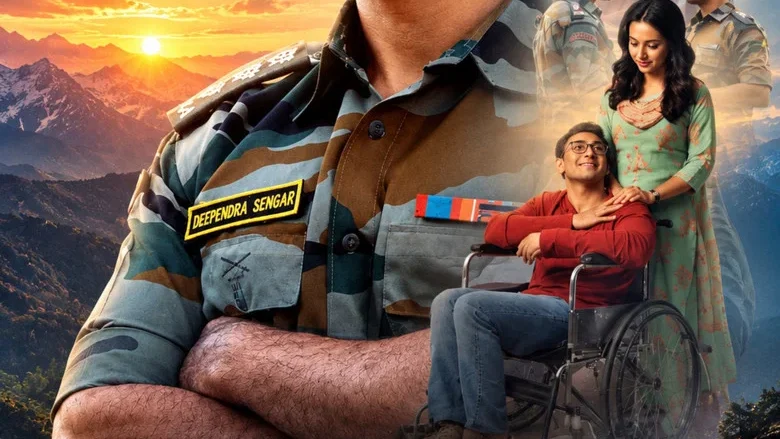
The opening image is a body that refuses to obey: a Special Forces officer on a Kargil ridge, then the same man staring at legs that have stopped answering. Vishal Mangalorkar’s film wants to be about what happens after the war ends, and for a while that ambition holds.
Major Deep Singh is Amit Sadh’s second consecutive study in men whose authority has been stripped from them. The trouble is that the film mistakes the stripping for the story.
A War Film That Fires Its Best Weapon In The First Act
The injury arrives early, and it arrives as a structural guillotine. What follows is not combat but rehabilitation, hospital corridors, and the slow humiliation of needing help to sit up. That is a genuinely unusual shape for a Hindi military drama, which usually saves its wound for the final reel and lets the hero limp toward a flag.
Mangalorkar stages the pivot with real discipline. The Special Forces sequences are lean and functional, all shouted orders and cramped bunkers, and the cut to silence is the film’s single most intelligent directorial choice. Where a lesser craftsman would have lingered on the explosion, he lingers on the stillness after it.
But the screenplay never quite figures out what to do with the space it has cleared. The rehabilitation arc proceeds in a straight line, and straight lines are where inspirational dramas go to flatten out.
When The Enemy Is A Spinal Cord, Suspense Has Nowhere To Sit
Here is the honest problem. The film has no villain, which is admirable in theory and enervating in practice. Deep’s opponent is his own body, and a body does not scheme, does not escalate, does not arrive at the third act with a fresh demand.
Instead the screenplay manufactures friction through Colonel Ranjeet Chaudhary, who refuses to coo over the patient. Sushant Singh plays him with a flat, unblinking delivery that lands like a dressing-down, and the film briefly crackles whenever he is in the room. He is not a villain. He is a wall, and walls are only dramatic if the hero keeps choosing to hit them.
The middle stretch struggles to find that choice. Scenes of physical therapy repeat the same emotional beat, and the film’s notion of escalation is a montage with slightly more sweat. Compare the spatial patience Mangalorkar’s peers brought to similar material in Poniiy, where the camera trusted a room to carry tension, and this film’s restlessness reads as nerves.
The Performance That Holds The Centre When The Script Wanders
Sadh does the hard thing well. Watch his hands in the early hospital scenes: they keep reaching for a task, patting the sheet, adjusting a strap that isn’t there. It is a soldier’s muscle memory denied an outlet, and it communicates more about grief than any monologue the script hands him.
There is a scene in which he tries to transfer himself from bed to wheelchair and fails, and Sadh plays the failure with a flat, embarrassed stillness rather than a wail. He looks away from the person helping him. That evasion is the performance’s spine.
The register recalls the clenched restraint he brought to Aakhri Sawal, though here the silence is physical rather than rhetorical. What Sadh cannot fix is the script’s habit of handing him speeches that explain the very thing his face has already said.
Amrita Puri gets the harder, less rewarded job. Jaya is written as support, and Puri resists the sainthood the page keeps offering her, letting fatigue flicker across her face in the moments between encouragement. One shot of her in a doorway, arms folded, watching her husband struggle, does more relational work than the dialogue that follows.
The Camera Retreats Exactly When It Should Push In
There is a visual grammar here that half-works. The military passages favour hard light and long lenses that compress bodies into formation; the hospital passages flatten into pale, over-lit rooms. The contrast is legible, even elegant, and then the film stops using it.
What it never solves is proximity. The most emotionally loaded moments are shot at a polite middle distance, as if the camera were afraid of the actor’s face. In a film about a man losing command of his own body, the lens should be close enough to feel the loss.
Elsewhere the film leans on swelling strings where silence would have cut deeper, and the recovery montages are cut to a rhythm that flatters effort rather than dramatising it. The craft is competent. Competence is the enemy here.
Why The Recovery Arc Refuses The One Question That Matters
The film is inspired by a real soldier’s journey, and it wears that inspiration like a badge, which is precisely where the trouble begins. Real-life uplift tempts filmmakers toward reverence, and reverence kills conflict.
Deep’s paralysis is treated as a hurdle to be cleared rather than a condition to be lived with. The screenplay races toward standing up again, and in doing so it quietly suggests that a life in a wheelchair is a life not yet begun. That is a troubling thesis for a film that otherwise wants to honour its subject.
The institutional and social dimensions of disability, the paperwork, the pity, the workplace, the family’s quiet recalibration, are gestured at and then abandoned. The film is more interested in the triumph than in the terrain. The genre sibling The Critique made a similar misstep, letting a strong central idea get buried under a screenplay that couldn’t sustain it.
The Commercial Arithmetic Of A ZEE5 Military Drama
This is a streaming release, which changes the stakes entirely. ZEE5 is buying a recognisable star, a patriotic frame, and a true-story hook, and the film delivers all three in a package that plays well on a phone screen during a commute.
For Sadh, the calculation is clearer. He has spent years building a reputation as the industry’s most reliable second lead, and these lead roles are his bid for a different tier. The film’s modest scale and straight-arrow emotionalism are a reasonable bet for a platform audience that wants uplift rather than ambiguity.
What it will not do is move the needle on the theatrical action market, where contemporary hindi action is currently defined by scale, spectacle, and a villain worth booing. This film has chosen the opposite road, and the choice is honourable even where the execution isn’t.
The Verdict: A Soldier’s Story That Salutes The Wound And Forgets The Man
Jeet Ki Zid means well, and means well loudly. It has a genuinely moving central performance, a sharp piece of institutional antagonism from Sushant Singh, and a structural instinct that puts the aftermath of war ahead of the fireworks. Those are not small things.
But a film about rebuilding a life cannot skip the messy, unheroic middle of that rebuilding. This one sprints past the wheelchair to get to the standing ovation, and in doing so it tells us that the only victory worth filming is the one where the legs work again.
Sadh’s face, in the quiet moments, knows better. The film around him doesn’t. That gap between what the actor understands and what the screenplay is willing to sit with is the whole review, and it is a gap that no amount of swelling music can close.
Ankit Jaiswal is the Chief Author, covering Indian cinema and OTT releases with honest, no-filler criticism. An SEO strategist by background, he brings a research-driven approach to film writing, cutting through hype to tell you exactly what's worth your time.