

The kiss is the whole movie. A seven-year-old in 1990s Goa decides that if his quarrelling parents will only press their lips together, a baby brother will arrive and the household will heal.
Kaushal Oza builds an entire feature on that child-logic premise, and for a while the innocence carries it.
When A Child Mistakes Expenses For The End Of The World
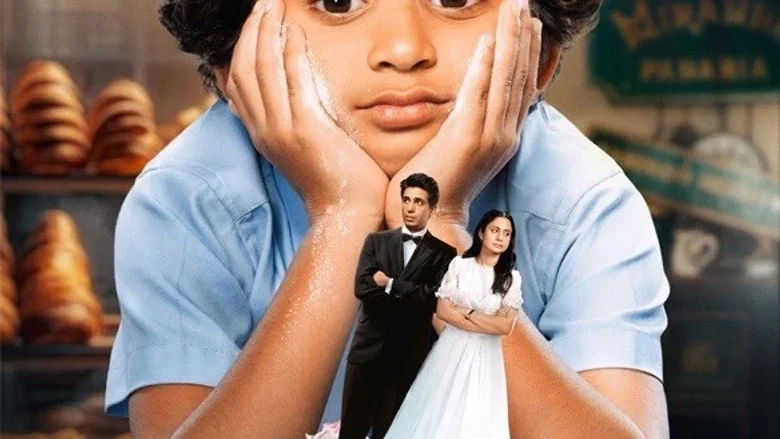
Thomas Miranda lives in Fontainhas with a piano-teacher mother and a baker father, and the film opens on the quiet observation that every friend of his has a sibling and he does not.
What he sees at the dinner table is not debt. It is a mystery with a solution, and Oza shoots the parental arguments from the boy’s eye-level so that ordinary money talk lands as threat.
That choice is the film’s cleanest idea: adult anxiety rendered legible only through a child’s misreading of it.
The Second Act That Repeats Its Own Best Joke
Once Thomas commits to engineering a reconciliation, the screenplay settles into a loop of schemes, each one chasing the same kiss.
There is charm in the persistence, but escalation never arrives, and the middle stretch begins to feel like the same scene redressed in different wallpaper.
Oza’s control of tone is steady, yet steadiness without variation curdles into monotony, and the film mistakes consistency for momentum.
The structural narrowness is the same trap that hollowed out the docu-fiction experiment of Doosra, where a strong formal conceit was asked to carry more weight than it could bear.
Rasika Dugal’s Exhaustion Does The Heavy Lifting
Jessie is written as the unavailable parent, and Dugal plays her exhaustion in the shoulders and the half-second delay before she answers her son.
She never performs weariness for the camera; she simply sits with a ledger in her lap and lets the boy’s questions bounce off her silence.
That restraint recalls the coiled domestic tension she sustained in Kartavya, though here the pressure is financial rather than conspiratorial.
Gulshan Devaiah’s Desmond works best in the bakery sequences, flour on his forearms, his patience thinning in the way he sets down a tray rather than in anything he says.
Young Hridansh Parekh holds the centre with sincerity rather than cuteness, and his certainty curdles slowly into confusion without a single precocious line.
The Period Texture That Refuses To Announce Itself
The pre-digital setting is the film’s quiet structural ally: a boy in this Goa cannot search for answers, so he must invent them.
Oza lets the neighbourhood breathe in wide, unhurried frames, and the light through the Fontainhas windows does more emotional work than any line of dialogue.
What the film lacks is a corresponding patience with its own plot, which keeps circling the same emotional beat instead of deepening it.
This is the opposite problem to the suffocating, pressure-cooker discipline of Dhood (Sandstorm), which tightened where this one merely repeats.
Four Banners, One Small Film, And A Sobering Opening
Luminoso Pictures, Civic Studios, Good Bad Films and Flip Films have pooled resources behind a title whose appeal is deliberately narrow.
That bet looks precarious: the opening drew thin crowds and weak visibility, and the film’s commercial ceiling is set by its own refusal to escalate.
For Rasika Dugal, the role confirms a career instinct for modest, character-first projects rather than star-vehicle arithmetic.
For the wider theatrical market, the takeaway is blunter, a gentle family fable needs either a name above the title or a hook loud enough to survive a Friday.
The broader turn toward small-scale domestic storytelling across contemporary Hindi family dramas is real, but goodwill alone does not fill a cinema.
The Kiss Arrives, And So Does The Truth
What the ending understands, without announcing it, is that Thomas’s theory was never really about a baby.
It was about the fear that his parents had stopped choosing each other, and the film lets him keep his wonder while surrendering the mechanics of it.
Oza refuses the tidy reconciliation the premise promises, and the refusal is the most honest thing in the movie.
Little Thomas is a small, sincere film that mistakes one good idea for a whole architecture, and its warmth cannot quite cover the empty rooms.
Ankit Jaiswal is the Chief Author, covering Indian cinema and OTT releases with honest, no-filler criticism. An SEO strategist by background, he brings a research-driven approach to film writing, cutting through hype to tell you exactly what's worth your time.