

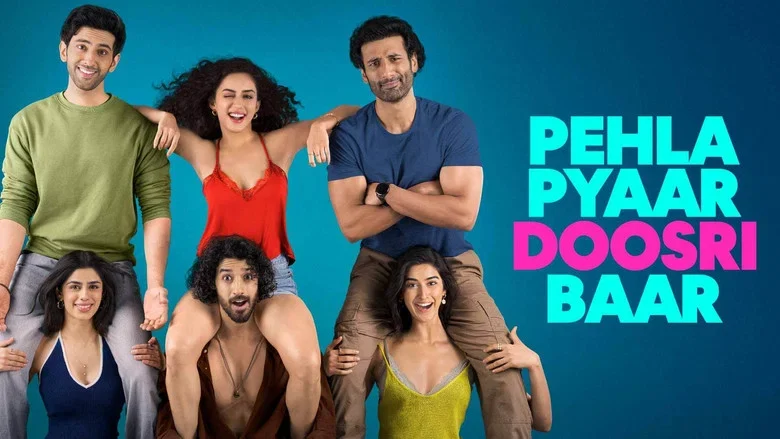
Anuj Saini opens on three colleagues marooned in a Delhi office, toasting promotions that never arrive and weddings they weren’t invited to.
What follows is a tipsy pact to crash a school reunion in the hills and resurrect the crushes they left unfinished, a premise with real ache buried under its comic swagger.
A Nostalgia Mission Built On A Reasonable Lie
The film’s opening stretch is its most honest. Gautam, Vedant and Shivi are drawn not through montage but through the specific humiliation of watching peers marry while their own targets stay static.
That loneliness gives the drunken Delhi-to-Mussorie decision a genuine comic charge. Three adults treating old crushes as a mission worth an impulsive trip is a fine engine for a friendship comedy.
Just as he anchored the sincere-but-conventional body-reclamation biopic Sumo Didi with patient, unshowy craft, Saini again prioritises emotional sincerity over flash, though here the sincerity has nowhere firm to land.
Three Romances, One Shared Hangover
The reunion establishes three parallel objectives with clean symmetry. Gautam chases Gehna, Vedant chases Simran, Shivi chases Karan, and the screenplay treats each as a separate test of adult honesty.
Gautam’s arc is the sharpest reversal. He pursues Gehna with a schoolboy’s fervour, then visibly flinches when she asks for permanence after intimacy; the fantasy was the point, not the woman.
Vedant’s track runs on a clock: a confession, a reciprocal bond, then the arrival of Simran’s fiancé Vikesh, whose wedding gives the second half its deadline. Shivi’s makeover for the womanising Karan ends in intimacy and the cold discovery that her feelings aren’t returned.
By the midpoint the three pursuits collapse into a collective hangover, and the friends redirect themselves toward rescuing Vedant’s romance. It’s a tidy structural pivot that the film never quite earns emotionally.
The Stillness That Should Have Manufactured Pressure
Sparsh Walia plays Gautam with a soft, slightly recessive physicality, shoulders turned in, eyes dropping before a confession, which makes his withdrawal from Gehna legible without a single explanatory line.
Alisha Chopra’s Gehna is the film’s most confident presence, delivering “hot hona bhi bohot badi problem hai” with a flat, amused self-awareness that briefly sharpens the whole enterprise.
Sargun Kaur Luthra gives Shivi real abrasiveness, gaalis included, and her “cute” versus “sexy” exchange with Karan is the film’s best comic beat, a joke that curdles into genuine hurt within seconds.
The restrained physical exhaustion of these performances recalls the psychological weight of the obsession drama in Tu Hai Meri Kiran, though Saini’s cast is asked to carry far thinner dramatic scaffolding.
When Chemistry Is The Missing Crew Member
The central problem is proximity. The camera places Gautam and Gehna at intimate distance, but the framing stays functional where it needs to be possessive, no held close-up, no refusal of the eyeline.
Mussoorie’s hills are photographed as pleasant postcard backdrop rather than as a space that presses on the characters. The corporate Delhi scenes, all fluorescent flatness and cramped cubicles, are the more expressive images.
The music is soulful and does much of the emotional labour the screenplay declines to do; when a song swells over a confession, you feel the gap where a written beat should be.
The screenplay resists the kinetic sensationalism that overtook Bhai Tera Star Hai, opting instead for a gentler, dialogue-led rhythm, but gentleness without friction reads as flatness.
Where The Ensemble Structure Genuinely Advances The Form
Credit where it’s due: this film distributes romantic disappointment evenly across gender lines rather than letting one couple monopolise the premise.
Shivi’s arc, for all its makeover-convention clumsiness, refuses to reward her transformation with the man she wanted. That refusal is more mature than the genre usually allows.
Fresh faces do the heavy lifting without established-star crutches, and the friendship functions as a comic safety net after each attempt fails. This patient, character-first approach signals a welcome tonal maturity across contemporary hindi comedys, even when execution lags intent.
A Newcomer Bet In A Crowded Exhibition Market
Luv Ranjan’s producer credit places this squarely in the friendship-rom-com lane his banner has mined for over a decade, and the commercial logic is legible: low-cost ensemble, hill-location romance, music-led marketing.
The opening-day India net of ₹0.22 crore is a sobering number for a theatrical newcomer bet, and it exposes how fragile the mid-budget Hindi rom-com pipeline has become against streaming.
For Saini and his cast, the film functions as an audition reel more than a box-office play. The franchise question isn’t sequel potential, it’s whether this template can survive at all in cinemas.
The Uncomfortable Resolution: Fantasy Meets A Wedding Date
The climax narrows everything into a deadline-driven intervention before Simran’s wedding concludes, and the film’s final movement argues that first love is a rehearsal for honesty rather than a destination.
That’s a decent thesis. It just arrives without the romantic combustion that would make us mourn the fantasy alongside the characters.
Pehla Pyaar Doosri Baar is a warm, well-intentioned reunion that forgets to bring the one guest the genre cannot survive without. It asks us to believe in second chances while demonstrating, scene by scene, exactly why the first ones failed.
Ankit Jaiswal is the Chief Author, covering Indian cinema and OTT releases with honest, no-filler criticism. An SEO strategist by background, he brings a research-driven approach to film writing, cutting through hype to tell you exactly what's worth your time.