

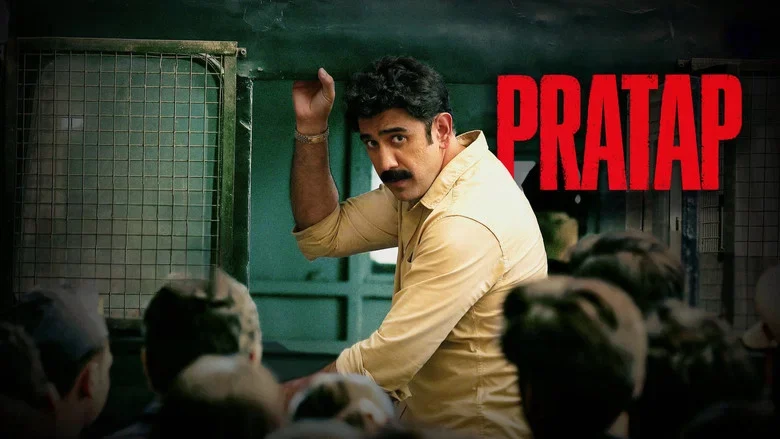
Amit Sadh has spent much of his career playing men whose authority is a thin coat of paint over something fractured. In Sachin Saraf’s Pratap, that fracture is the entire architecture.
The film opens on an arrest that should be routine and becomes a death that shouldn’t be. A wanted man is caught in a parking lot, dies of what looks like a heart attack, and a bystander’s phone camera turns the ambiguity into a national referendum on everything Pratap Ranade has ever done.
The Viral Video Is The Most Honest Antagonist The Film Has
Saraf understands that the modern police thriller can no longer pretend the public isn’t watching. The recorded footage does what a hundred internal-affairs subplots couldn’t: it strips a decorated encounter specialist of the fiction that his authority is natural rather than granted.
Twenty-six prior killings, reopened in the space of a news cycle. The screenplay escalates cleanly from one death to a systemic audit, and that escalation is the film’s most disciplined piece of construction.
The viral clip is also the film’s smartest genre device. It converts a procedural into a story about perception, and perception is what the thriller has always really been about.
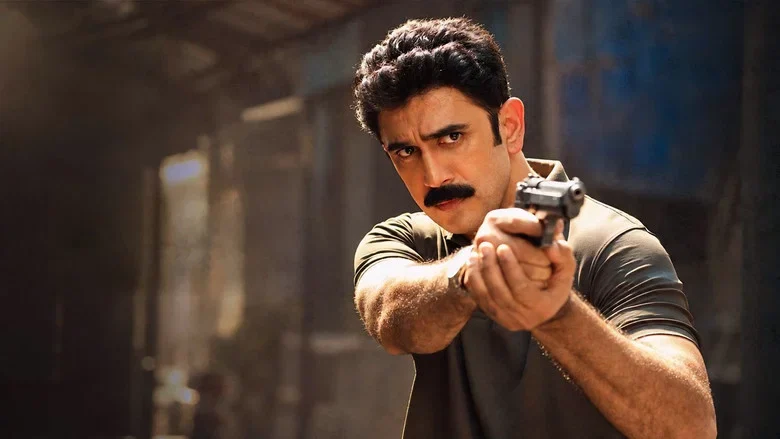
Prison Is Where The Film Stops Performing And Starts Thinking
The transition to Mumbai Central Prison is where Pratap locates its real engine. A man who commanded spaces now occupies a cell, and the film’s camera language shifts accordingly: wider frames, fewer cuts, more waiting.
Seema Biswas’s Meera Sen is the perfect instrument for that shift. She doesn’t rage at Pratap; she processes him. Her authority is procedural, unglamorous, and utterly indifferent to his legend, which is precisely what makes it terrifying to him.
Biswas plays the jailer with a stillness that reads as institutional, not personal. She isn’t his enemy; she’s the system he used to be. That distinction is the film’s best idea.
The prison material carries a familiar weight, though. It echoes the kind of contained psychological pressure that Kaali Kheti managed with more restraint, and where that film trusted silence, Pratap occasionally reaches for explanation it doesn’t need.
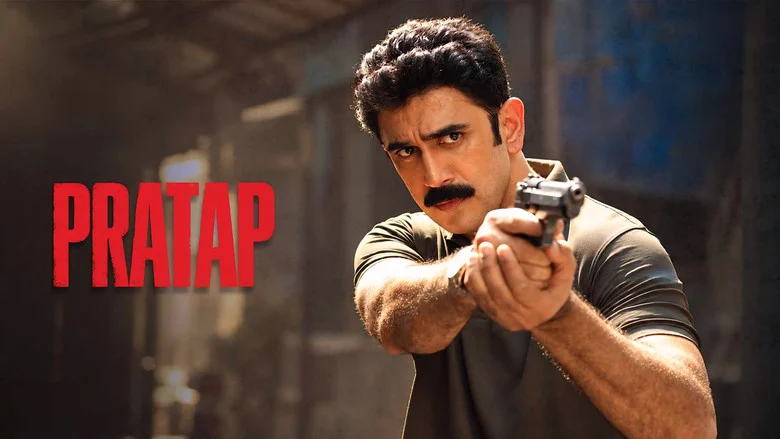
Amit Sadh Plays The Collapse, Not The Comeback
Sadh’s performance is built around subtraction. The early scenes give him posture and volume; the prison scenes take both away, and what’s left is a man learning that his reputation was never his.
His best moments are the quietest: a hand kept still on a table, a jaw that doesn’t move when it should. The performance recalls the exhausted resolve he brought to Jeet Ki Zid, but this time the war has already been lost before the first frame.
What Sadh doesn’t get is a convincing antagonist to push against. The conspiracy is structural, not personal, and a thriller needs a face. The film’s refusal to provide one is thematically defensible and dramatically costly.
The supporting ensemble, including Esha Deol and Tigmanshu Dhulia, registers as texture rather than function. They appear, they register, they recede. The film’s attention is monogamous, and it only ever loves its protagonist.
Saraf’s Direction Finds The Right Rooms And Then Hesitates
There’s real control in how Saraf stages the parking-lot death: the camera stays at bystander distance, refusing the spectacle the material invites. That choice is the film’s moral position in a single shot.
The prison sequences are similarly disciplined, with fluorescent light and hard angles doing the work that dialogue shouldn’t. But the film’s second half grows impatient, and the conspiracy reveal arrives with more explanation than the first hour ever required.
The tonal lineage here runs through the newer wave of Hindi thrillers that treat institutional rot as atmosphere rather than plot. Films like Dhood (Sandstorm) understood that the pressure comes from the environment, not the exposition. Pratap knows this intellectually but doesn’t always trust it.
Anil Akki’s lensing does its best work in the middle stretch, where the frame gets tighter and the light gets harsher. The score by Rohan Rohan is functional where it should be brave, pushing when the image is already doing the work.
The Conspiracy Is The Film’s Weakest Link And Its Biggest Ambition
When the story expands from personal exoneration to a state-linked network, it gains scope and loses grip. The mechanism connecting the heart attack, the video, and the larger conspiracy is gestured at rather than dramatized.
That’s a real structural cost. A thriller earns its final act through the precision of its middle, and Pratap spends its middle on atmosphere rather than mechanics. The result is a climax that feels earned emotionally and rushed logically.
The escape sequence and the final confrontation are staged with conviction, but they’re solving a puzzle the film never fully assembled on screen. Ambiguity is a virtue; incompleteness is a different thing.
The Box Office Math For A Mid-Budget Institutional Thriller
Produced by Pradeep Rangwani, Pratap arrives into a market where the crime thriller is no longer a guaranteed draw unless it carries a franchise or a star whose name alone opens a weekend. Amit Sadh is respected, not yet bankable in that sense.
The film’s theatrical ceiling is therefore modest, and its real commercial life will likely be on streaming, where adult-skewing institutional dramas find their audience without the pressure of a Friday number. That’s not a failure; it’s a distribution reality.
For the broader ecosystem of contemporary Hindi thrillers, the more interesting question is whether mid-budget films like this can sustain a theatrical window at all, or whether the form is quietly migrating to the small screen.
A Film That Knows What It’s Against, Not Quite What It’s For
Pratap is at its strongest when it’s simply watching a powerful man learn that power was never his. Sadh gives that humiliation a physical grammar, and Biswas gives it a face.
What the film doesn’t quite solve is the question it raises about its own genre: if the enemy is a system, who do we watch the hero defeat? The answer it offers is himself, which is honest but not entirely satisfying.
It’s a film worth seeing for the prison stretch alone, and worth arguing with for everything after it. The camera knows when to stay still; the screenplay doesn’t always know when to stop talking.
Ankit Jaiswal is the Chief Author, covering Indian cinema and OTT releases with honest, no-filler criticism. An SEO strategist by background, he brings a research-driven approach to film writing, cutting through hype to tell you exactly what's worth your time.