

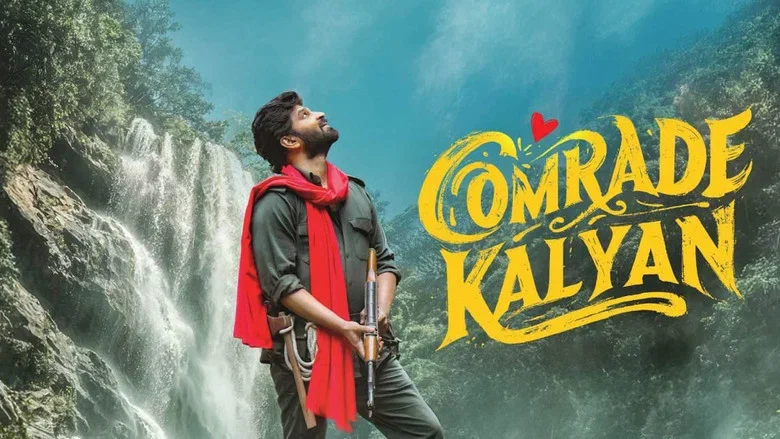
Janakiram Marella opens on a projector that has no business still running. It is 1992, somewhere along the Andhra Pradesh–Odisha border, and Kalyan is threading a print of some banned revolutionary melodrama through a machine older than most of his audience. The theatre is bleeding money. The seats are cracked. The whole enterprise is held together by ideology and stubbornness in roughly equal measure, and Sree Vishnu plays that stubbornness with a slack-jawed weariness that lands somewhere between defiance and exhaustion. It is a genuinely arresting image: a man performing radicalism for a paying crowd because the alternative is closing the shutters.
That image is also the film’s best idea, and it arrives in the first fifteen minutes. What follows is a romance with Sitara, a woman from across the border whose presence gives Kalyan a second, more personal reason to keep the lights on. Mahima Nambiar plays her with a quiet watchfulness that the screenplay never quite rewards, but the dynamic works well enough to establish stakes: this man needs money, he needs love, and he has a projector.
When A Con Becomes A Kidnapping, The Comedy Loses Its Footing
The pivot into farce is where Comrade Kalyan reveals both its ambition and its structural trouble. Kalyan and Dubai Babu, his accomplice and comic foil, hatch a scheme to impersonate a wanted rebel and claim the government’s rehabilitation reward. Satya’s Dubai Babu is all nervous energy and half-formed plans, and the early planning sequences have a scrappy, improvisational charm. Two men performing a role they barely understand, hoping the performance holds long enough to cash out.
The problem is that the film never quite commits to the absurdity it has engineered. The deception escalates into a politician’s kidnapping, and the tonal shift is abrupt enough to feel like a different movie has wandered into the frame. The comedy of impersonation should curdle into genuine danger, but the direction keeps reaching for laughs in moments that demand dread. Where a sharper film would let the silence do the work, Marella keeps the score busy and the pacing frantic, as if afraid the audience might notice the gears grinding.
Compare this to the calculated patience of Drishyam, where a similar premise of ordinary people improvising under pressure derives its tension from what is withheld rather than what is announced. Here, the film explains its own cleverness at every turn, and the result is a caper that feels less dangerous than it should.
Sree Vishnu’s Comic Instincts, And The Weight They Cannot Carry
Sree Vishnu has built a career on playing men who are slightly out of their depth and entirely aware of it, and Kalyan fits that mould comfortably. Watch his face during the rebel-impersonation rehearsals: the flicker of doubt that crosses his features before he commits to the bit, the way he holds his posture a beat too long when he thinks no one is watching. It is a performance of small, precise calibrations, and for the first hour it is enough to carry the film.
What Vishnu cannot do is make the third act’s panic feel earned. When the kidnapping goes wrong and the stakes become genuinely lethal, his register shifts into a higher, more frantic key that sits awkwardly against the film’s earlier looseness. The comparison to the miserly desperation Upendra Limaye brought to Toaster is instructive: Limaye understood that genuine fear in a comedy comes from stillness, not volume. Vishnu, given a script that keeps pushing him toward hysteria, never finds that quieter gear.
The supporting cast is a mixed bag. Satya’s Dubai Babu gets the film’s best comic beats, particularly a sequence where he attempts to negotiate with a man he believes to be a government agent while visibly sweating through his shirt. Raadhika Sarathkumar and Shine Tom Chacko are present but dramatically underused, their characters never given enough screen time to register as anything more than plot furniture. Upendra Limaye, whose comic timing could have been a genuine asset, is stranded in a role that requires him to do little more than look stern in the background.
A Period Setting That Never Quite Becomes A Character
The 1992 borderland setting is the film’s most distinctive asset, and also its most squandered. The visual contrast between the decaying theatre, with its peeling posters and flickering projector, and the sun-bleached political spaces of the kidnapping sequence is genuinely striking. The production design communicates economic stagnation without overstatement, and the revolutionary film imagery that Kalyan screens becomes a neat visual motif for a man whose entire life is built on borrowed narratives.
But the period detail rarely functions as more than backdrop. The Naxal-dominated environment is invoked rather than explored, and the political violence that should give the comedy its edge remains abstract. A film that places a fake rebel at the centre of a real political crisis has an obligation to make that crisis feel tangible, and Comrade Kalyan never quite manages it. The screenplay treats the Naxal conflict as a source of comic misunderstanding rather than a genuine threat, and the result is a film that wants the frisson of danger without the weight of consequence.
The editing in the second half does the film no favours either. The kidnapping sequence, which should be the climax, is cut together with a restlessness that undermines its tension. Scenes end before they have a chance to breathe, and the film’s attempts at suspense are consistently undercut by a pace that feels less like urgency and more like anxiety. The genre sibling Bhai Tera Star Hai faced similar challenges in balancing comedy with genuine stakes, and while that film’s energy was more consistent, both share a tendency to mistake freneticism for momentum.
The Uncomfortable Question Of What The Joke Is Actually About
There is a version of this film that is genuinely provocative: a story about a man who exploits revolutionary politics for personal gain, only to discover that the symbols he has been performing carry real consequences. That film would have something to say about the commodification of ideology, about the gap between performance and belief.
Comrade Kalyan gestures at that idea without committing to it. The ending, which I will not spoil, resolves the kidnapping crisis in a manner that feels designed to restore the status quo rather than interrogate it. The film wants to have it both ways: to use political violence as a source of comic tension while ultimately treating it as a problem that can be solved by a sufficiently clever scheme. It is a cop-out, and it leaves the film’s most interesting questions unanswered.
What remains is a comedy that works in fits and starts, anchored by a lead performance that is more committed than the material deserves. The box office trajectory, opening at a modest ₹2.10 crore before climbing to nearly ₹3 crore by day three as tracked across cinema hubs like Filmyfly, suggests an audience willing to give it a chance. Whether that goodwill holds through word of mouth depends on how forgiving viewers are of a film that keeps promising to be about something and then changing the subject.
This kind of uneven, personality-driven comedy is a staple of contemporary Telugu cinema, and there is something admirable about its refusal to play safe. But admiration for ambition is not the same as satisfaction with execution, and Comrade Kalyan never quite earns the emotional payoff its premise sets up.
Rating: 2.5 / 5
The final shot lingers on a projector that is still running, still throwing light against a wall, still performing for an audience that may or may not be there. It is a lovely image, and a melancholy one: the show goes on because stopping is not an option. The trouble is that by the time we reach it, the film has spent so much energy chasing its own plot that it has forgotten to make us care whether the lights stay on.
Ankit Jaiswal is the Chief Author, covering Indian cinema and OTT releases with honest, no-filler criticism. An SEO strategist by background, he brings a research-driven approach to film writing, cutting through hype to tell you exactly what's worth your time.