

Balaji Mohan opens on a Meerut courtyard in disarray, steel thalis stacked crooked, a leaking cooler, cousins shouting over a television, and then Yami Gautam Dhar walks in and the frame tidies itself. That single visual correction is the film’s entire thesis: order arrives, and nobody asks what it costs.
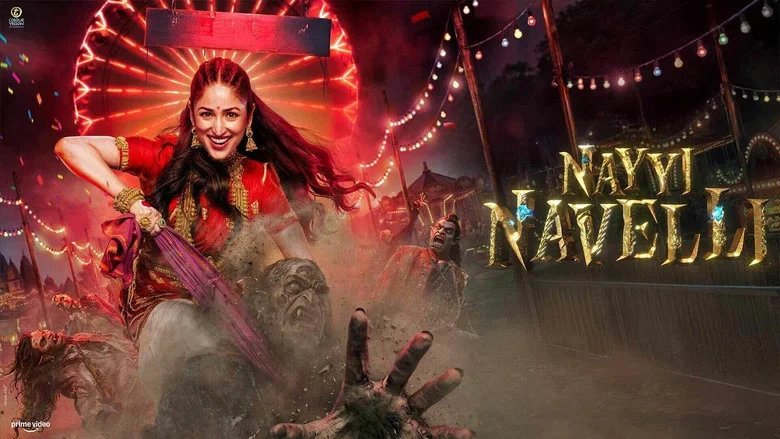
A Perfect Bride Is The Most Frightening Thing A Joint Family Can Produce
Himanshu Sharma’s story understands that North Indian households do not fear outsiders; they fear the outsider who outperforms them at being inside. Mohini cooks, mends, mediates, and within twenty minutes the Awasthi home has stopped fighting. The comedy here is structural, not verbal, the family’s chaos is the baseline, and Mohini’s competence is the punchline.
What the screenplay grasps, and what most witch narratives miss, is that the daayan myth is fundamentally a story about labour. A woman who does everything perfectly and asks for nothing is, in a joint-family economy, a threat to the very logic of obligation that holds the house together.
Adinath Kothare Plays The Only Man In Meerut Who Reads Subtext
Raja Awasthi is the film’s load-bearing wall. Adinath M. Kothare plays him not as a hysteric but as a man quietly cataloguing inconsistencies, a pause held half a beat too long at the dinner table, a hand that never quite touches the serving spoon, a smile that arrives before the joke does.
His suspicion is dramatised through posture rather than dialogue. He sits angled away from Mohini at every meal, shoulders turned toward the door, and the camera keeps catching him watching her hands rather than her face, the instinct of a man who has decided the threat lives in the gesture, not the expression. It is a disciplined piece of physical acting.
The screenplay, unfortunately, gives him fewer discoveries than it gives him hunches. Raja’s investigation advances largely through reaction, and by the midpoint the audience is ahead of him by a comfortable margin.
Yami Gautam Dhar Builds Mohini Out Of Withheld Movement
Gautam Dhar’s central choice is stillness. Where the family bustles, Mohini settles, spine straight, palms flat on her knees, gaze level and unhurried. The performance works because she never plays menace; she plays service, and lets the framing supply the dread.
The tonal hinge arrives in a kitchen sequence where she turns from a simmering pot to face her sister-in-law, and the shot holds one beat past comfort. Nothing changes in her face. Everything changes in the rhythm of the scene. That is editing and performance working in tandem, and it is the film’s most persuasive argument for itself.
It is a register she has been circling for a while, the controlled domestic surface with something harder underneath, the same tension she located in the patchy but genuinely unsettling System. Here the material is stronger and the discipline sharper.
The Supporting Household Exists To Be Charmed, Not To Be Complicated
Mita Vashisht’s Pinky Bua gets the film’s best comic timing, a woman who weaponises approval, praising Mohini in a register calibrated to irritate everyone else in the room. Sunita Rajwar’s Asha Devi registers mainly as ambient anxiety, folded into the ensemble rather than given a confrontation of her own.
The remaining relatives, dadi, chacha, tau ji, the IAS nephew, function as a chorus of approval. They are warm, well-cast, and dramatically inert. Once the household has been won over, the film has nowhere to send them, and the second hour feels the absence of a genuine dissenting voice besides Raja’s.
It is a structural problem rather than a performance one: an ensemble this large needs at least two people pulling in opposite directions, and here the family moves as a single grateful organism.
G. V. Prakash Kumar Scores The Comedy And Under-Scores The Threat
The film’s most curious technical decision is that its music is funnier than its horror. G. V. Prakash Kumar’s cues lean into the domestic-comedy register, with percussion marking Mohini’s household victories, and the supernatural material is largely left to silence and ambient room tone.
That restraint is admirable in principle. In practice it means the film’s scare sequences rely on shot duration rather than sonic pressure, and the climactic confrontation feels lighter than the premise has earned. The supernatural is present, but it never quite lands with weight.
The genre blending here is looser than the more disciplined tonal control on display in Jailer 2, where escalation is calibrated scene by scene. Mohan’s film shifts registers without always announcing the gear change.
A Witch Story That Keeps Its Monster Polite
Where the screenplay is most interesting is also where it is most cautious. Mohini is never confirmed as wholly malevolent, and the film seems genuinely unsure whether it wants a villain or a tragedy. That ambiguity is thematically rich and commercially safe, and it costs the third act its teeth.
The confrontation resolves because the plot requires resolution, not because the characters have earned a reckoning. A more committed version of this story would force the family to admit what they wanted from Mohini, and what they were willing to overlook to keep getting it.
The film gestures toward that idea, particularly in the way the household’s gratitude curdles into dependence, and it lands closer to the moral seriousness of something like Hanuman Ansh than its marketing suggests. It simply declines to follow the thought to its end.
Colour Yellow Bets On A Hybrid The Exhibition Market Hasn’t Fully Priced
Aanand L. Rai’s Colour Yellow Productions has built its slate on exactly this kind of middle-budget, star-led, tonally hybrid Hindi film, and the Amazon MGM Studios partnership, the banner’s first with the studio, signals an appetite for theatrical product that can travel beyond the mass-action corridor.
The commercial logic is legible. Gautam Dhar has become one of the more reliable theatrical draws in the mid-budget bracket, and a Meerut-set family entertainer with a supernatural hook sits in a lane with less competition than the tentpole calendar. Advance bookings suggest measurable pre-release interest, though nothing in the available numbers yet establishes profitability.
What remains unresolved is whether the daayan-in-the-joint-family premise can sustain a franchise or remains a one-film conceit. The film’s ending leaves the door ajar without committing to what walks through it, which is a hedge rather than a plan.
For a market increasingly saturated with sequels and remakes, a modestly scaled original with a genuine performance at its centre is a reasonable bet. It is also, on this evidence, an unfinished one.
Nayyi Navelli is at its best when it trusts Yami Gautam Dhar to do nothing at all, to stand in a doorway and let a household reorganise itself around her silence. The film’s final image returns to that stillness, and it is the only moment where the dread fully arrives.
Everything before it is charming, well-acted, and slightly too eager to be liked. A witch who wants your approval is not yet a witch worth fearing.
Ankit Jaiswal is the Chief Author, covering Indian cinema and OTT releases with honest, no-filler criticism. An SEO strategist by background, he brings a research-driven approach to film writing, cutting through hype to tell you exactly what's worth your time.