

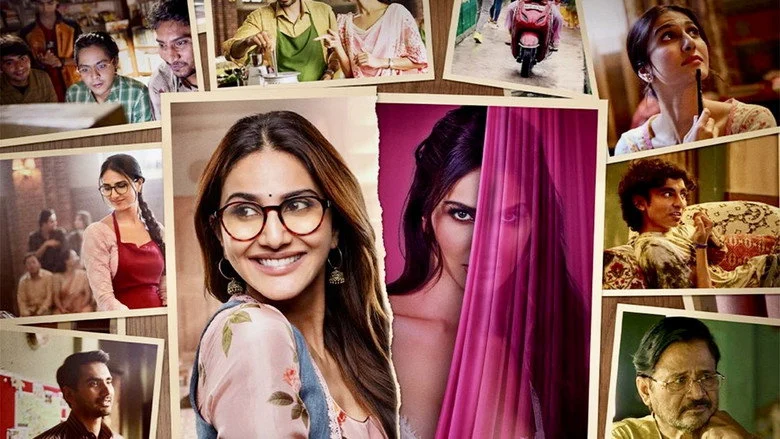
There’s a moment in the teaser where Vaani Kapoor’s protagonist stands in a salwar-suit and glasses, the picture of middle-class respectability, while the world around her projects an entirely different identity onto her face. That single image, built on the contrast between how she presents herself and how society reads her, is the sharpest thing about this Maddock Films production, a Hindi social comedy that lands on Zee5 with a premise more interesting than its execution.
Vaani Kapoor’s Calculated Gamble on Identity
Kapoor’s casting is the film’s boldest move. She plays a woman whose resemblance to an adult film star triggers a cascade of public misunderstandings, and the role demands a careful balance between innocence, embarrassment, and simmering social pressure. The actress commits to the awkwardness of the situation, letting her character’s discomfort register in small physical choices rather than broad comic gestures.
It’s a deliberate departure from her prior screen image, and the shift signals that Maddock understood exactly what they were buying with this script. Kapoor carries the weight of the premise on her shoulders, and the film works best when it trusts her to hold the screen without over-explaining the joke.
Direction and Screenplay: A Strong Start, A Repetitive Middle
Sonali Rattan Deshmukh directs with a clear sense of what this film wants to be, a social satire that uses mistaken identity as a mirror for respectability politics. The 1990s setting is a smart choice, grounding the commentary in a period where labels carried even more weight than they do today.
But the screenplay, credited to Sumit Ghildiyal and Suman Adhikary, leans too heavily on premise repetition rather than progression. The misunderstanding-driven sections circle back to the same beats, and the narrative’s linear structure doesn’t leave enough room for the complications to escalate into something genuinely uncomfortable or funny.
Genre-Core Execution: Social Comedy With Restraint
The film positions humor around awkward social assumptions rather than physical comedy or slapstick, which is a refreshing choice for a Hindi comedy. The sequence where her resemblance triggers misunderstandings in everyday settings, shopping, social gatherings, neighborhood interactions, works because it stays grounded in recognizable middle-class anxieties.
Deshmukh frames the protagonist through public perception and private identity conflict, using the salwar-suit and glasses as visual shorthand for the gap between appearance and assumption. It’s a restrained approach that respects the premise’s intelligence, even when the writing doesn’t quite match the ambition.
Where the film stumbles is in its middle section, where the single gimmick premise starts to feel stretched. The dialogue, “Play by the book in the day and re-define it by night, what makes a perfect woman?”, hints at a sharper satire that the script never fully commits to exploring.
For more Hindi social comedies and dramas that tackle identity with sharper edges, browse our Hindi Drama reviews for similar recommendations.
Supporting Cast: The Reliable Ensemble Anchors the Tone
Raghubir Yadav and Brijendra Kala are exactly the kind of character actors this material needs, both bring a lived-in quality to their scenes, anchoring the film’s comic-social texture with the ease of performers who’ve done this dance many times before. Yadav’s presence signals a certain authenticity, while Kala’s positioning for character-comedy and conversational scenes gives the film a familiar, comforting rhythm.
Ishwak Singh as the male lead offers a softer, more restrained counterpoint to Kapoor’s escalating social predicament. His casting suggests the film wanted a gentler emotional register rather than a confrontational arc, which fits the overall tone. The rest of the ensemble, Prayrak Mehta, Geeta Tyagi, Namik Paul, Shweta Pasricha, fills out the world competently, even if the research doesn’t offer enough detail to assess their individual contributions beyond their presence.
Audience Reception and The Long Road to Release
The film’s journey to Zee5 was described as long-delayed, and that gap between production and release has created limited early audience discussion. The social media conversation that does exist centers on the freshness of the premise and Kapoor’s unusual casting choice, with some viewers already expressing concern about overreliance on a single gimmick.
There’s no verified controversy here, no censorship battles, no political firestorm, which is itself notable for a film that engages with adult-film stigma and social labeling. The absence of public backlash might reflect the film’s modest profile, or it might suggest that the satire is too gentle to provoke. For a film about the weight of public judgment, it’s oddly fitting that the audience response remains, for now, a quiet one.
The film’s identity-and-self-acceptance angle gives it thematic clarity, but that clarity comes at a cost, there’s no antagonist to push against, no villain to defeat, just the slow grind of social perception. The premise is distinct, the casting is a genuine departure, and the 1990s setting supports the commentary effectively. But a strong idea needs a screenplay that builds on it, and here the execution stays too comfortable, too safe, too willing to repeat the same misunderstanding instead of deepening it.
Watch it on OTT for Kapoor’s committed performance and the film’s honest intentions. It’s the kind of social comedy that works better as a conversation starter than as a fully satisfying narrative, a film you’ll discuss more than you’ll remember. Sarvagunn Sampann earns a modest 2.5 out of 5 for its premise and performances, even if the script never quite catches up to its own ambitions.
If you’re drawn to identity-driven narratives with memory and perception at their core, Abeyance review explores similar themes through a thriller lens.
For another take on a promising premise struggling to find its voice, Apology verdict offers a comparable study in unfulfilled potential.
Ankit Jaiswal is the Chief Author, covering Indian cinema and OTT releases with honest, no-filler criticism. An SEO strategist by background, he brings a research-driven approach to film writing, cutting through hype to tell you exactly what's worth your time.