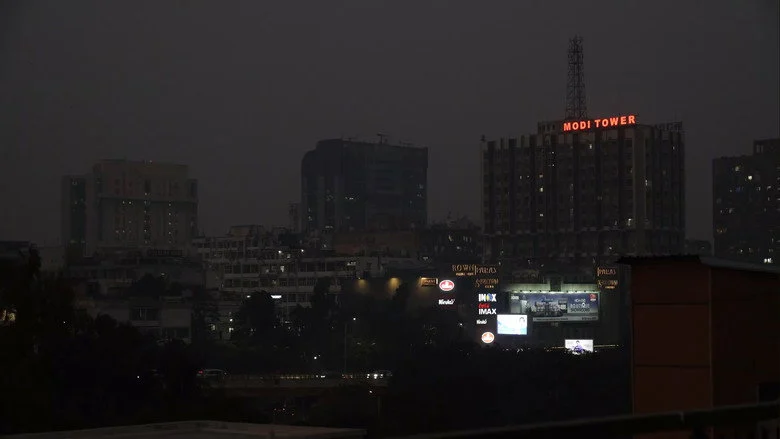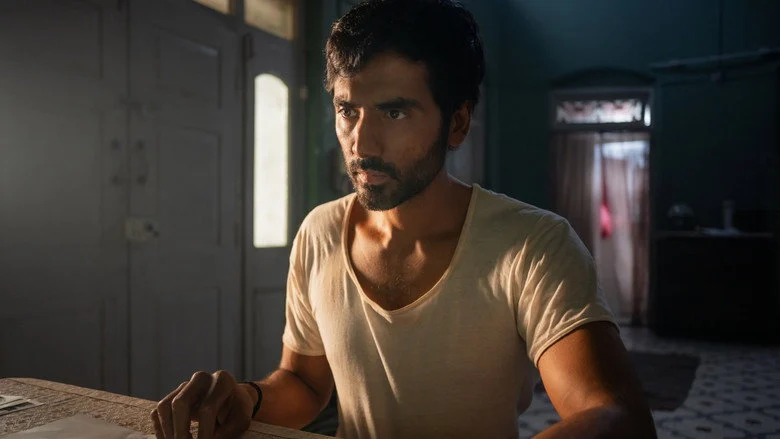


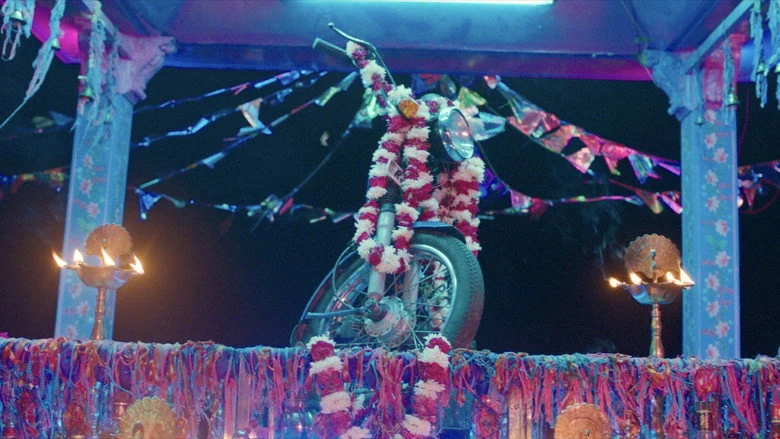
In a dusty village square, a motorbike becomes an object of reverence, villagers gather around it, treat it as a divine sign, and slowly organize their lives around its supposed sanctity. That single image, absurd and uncomfortably recognizable, is the beating heart of Ritwik Pareek’s Dug Dug, a satire that knows exactly what it wants to say but struggles to find enough to say it with.
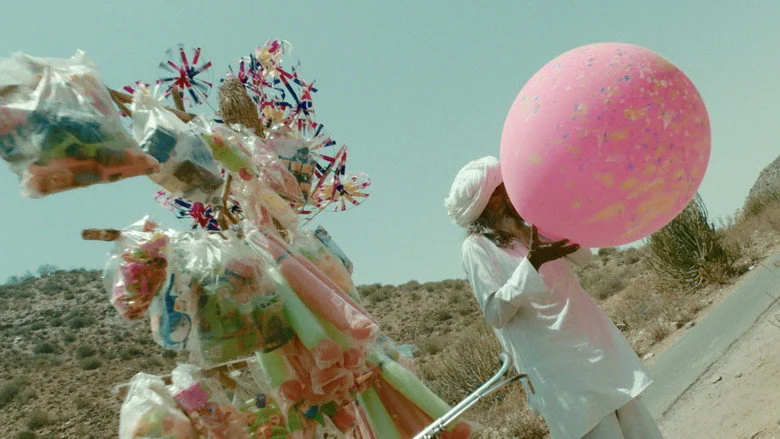
Altaf Khan’s Restrained Thakur Sa Anchors the Village Chaos
Altaf Khan plays Thakur Sa, the figure who benefits most from the village’s newfound devotion. His performance is adequate rather than electrifying, he lets the situation do the heavy lifting, reacting with a measured calm that suits the film’s observational tone.
Khan doesn’t dominate scenes with theatrical flair. Instead, he functions as the still point around which the frenzy revolves, and that restraint keeps the satire grounded even when the premise threatens to float away.

Pareek’s Direction Has a Clear View but a Thin Script
Ritwik Pareek, who also wrote the screenplay, demonstrates strong control over his social commentary. The film consistently knows who it’s mocking, the commercializers of faith, the eager believers, the local power structures that profit from credulity.
The weakness is structural. Pareek’s idea is compact enough for a sharp short film, but stretched to 1 hour 45 minutes, the material shows visible seams. The pacing drags in the second half, and what should feel like escalating absurdity instead settles into repetition.
The Satire Works Best When It Stays Observational
Dug Dug is at its sharpest when it simply watches the village organize itself around the motorbike. The scenes of collective devotion, where belief becomes commerce and local leaders start managing the narrative, carry genuine critical bite. This is satire aimed at systems, not easy targets.
The film builds its humor from community reaction rather than slapstick. There’s no villain twirling a mustache, the antagonist is the social machinery of exploitation itself, which is both the film’s boldest choice and its most limiting one. Without a human face to the manipulation, the conflict stays diffuse.
When the satire pivots from absurdity into social criticism in the later stretches, you can feel the film finding its true register. But by then, the extended setup has already cost it momentum, and the payoff feels earned rather than explosive.
The Ensemble Serves the Premise Without Elevating It
Gaurav Soni’s Pyare Lal is described as average in reviews, and that assessment feels fair, he’s present, functional, and never memorable. Yogendra Singh Parmar’s Badri fares similarly, earning a “so-so” label that captures his workmanlike contribution to the communal conflict.
Durga Lal Saini’s Manfool rounds out the main trio with an ordinary turn that supports the village dynamic without adding texture. The supporting cast, including Sarvesh Vyas’s police inspector and Raju Gujjar’s Panky Ji, fills out the social canvas competently, but no one breaks through the material’s limitations.
This is an ensemble film where the premise is the star, and the actors are asked to be conduits rather than personalities.
If you’re in the mood for more Hindi-language satire that examines social behavior with a critical eye, our Hindi Satire reviews cover similar ground.
The A Certificate and the Missing Controversy
There’s no verified controversy attached to Dug Dug, which is itself notable for a film taking aim at religious commercialization. The A certificate suggests content that pushes past family-friendly norms, but no censorship dispute has been reported.
What’s more interesting is the audience response, a BookMyShow score of 8.2/10 from 75+ votes suggests viewers found genuine value in the satire, even as critics noted its structural flaws. The Times of India’s 3.5/5 rating aligns with that broadly positive reception.
One critic called it “a sharp satire on the commercialisation of faith and belief, ” while another observed that “Dug Dug is like a short story blown up into a full-length feature film.” Both are accurate, and the film exists in that tension.
I find myself landing closer to the second assessment, the idea is excellent, but the execution needed either more narrative complexity or a shorter runtime.
Dug Dug is best experienced on OTT, where its modest scale and conversational pacing fit comfortably. If you appreciate pointed social commentary and can tolerate a stretched middle act, there’s real value here. If you’re expecting a conventional mystery or high-energy commercial plotting, look elsewhere. The film earns its 3.5/5 with a sharp premise that deserved a tighter container, watch it for the idea, stay for the village it builds around it.
For a similar exploration of restraint anchoring dialogue-heavy drama, check out our take on I m review.
If you’d rather see warmth struggle against a thin script, Daadi Ki verdict offers that comparison.
Ankit Jaiswal is the Chief Author, covering Indian cinema and OTT releases with honest, no-filler criticism. An SEO strategist by background, he brings a research-driven approach to film writing, cutting through hype to tell you exactly what's worth your time.