

The film opens with Veera Anbarasu’s commando returning home as a Republic Day chief guest, ceremonial flags framing a soldier who seems more comfortable with protocol than conversation. From this public spectacle, the narrative pivots to a journey toward Chennai where he meets Angel Sharma’s Ph.D. student, and the film’s real business begins.
This is not a romance that announces itself. It builds through shared silences and measured glances, a deliberate choice that defines the entire 2h 26m runtime.
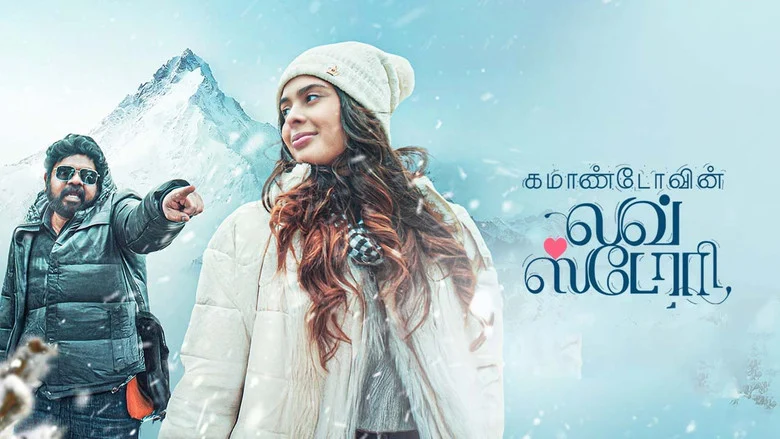
Veera Anbarasu’s Controlled Silence Becomes the Film’s Language
Anbarasu, who also directs, plays the commando with a restraint that suits the material. His performance is built around what he does not say, particularly in the homecoming sequence where the weight of public duty visibly presses against private feeling.
The unsent-letter sequence, the film’s most praised moment, depends entirely on his ability to make stillness readable. He manages it, turning what could be a passive beat into the emotional hinge of the story.
His double role as director and lead means the film’s measured pacing is also his responsibility, a gamble that mostly pays off in the final stretch.
The Genre’s Slow-Burn Execution Holds Its Ground
As a drama, the film commits fully to mood over momentum. The middle section, where the commando and the Ph.D. student travel and bond, has been criticized for limited dramatic variation. I found myself checking the runtime during this stretch, though the quiet interaction does lay necessary groundwork.
The romance is built on restraint rather than confession, which is refreshing in a landscape of loud declarations. The journey sequence works because both actors understand that less is more, allowing the bond to form without forcing it.
The unsent letter functions as the narrative’s single most effective device, concentrating the story’s emotional payoff into one object. It is a familiar trick, but the film executes it with enough sincerity to land the landing.
Supporting Cast Provides Texture, Not Distraction
Angel Sharma serves as the emotional counterweight to Anbarasu’s stoic commando. Her Ph.D. student is defined through the quiet bond rather than large dramatic scenes, and she carries that understated responsibility well.
Babloo Prithiveeraj and Robo Shankar appear within the family-and-community framework that surrounds the central pair. Their presence signals the film’s intent to ground the romance in a wider social reality, even if neither gets a scene that stands out sharply.
The ensemble, including A. Aakkash Muthu and Jangiri Madhumitha, fills out the world competently without ever pulling focus from the central relationship.
A Familiar Framework With a Gentle Touch
The film does not pretend to reinvent the separation-and-closure romance template. Duty interrupts love, a letter carries the weight of unspoken feeling, and the ending hinges on whether closure arrives in time. What distinguishes this effort is the sincerity of its execution.
Audience scores on BookMyShow sit at 4.9 out of 10 from 21 votes, a modest reception that reflects the film’s niche appeal. Music, with Karthik Raja attached to score, has been repeatedly highlighted as a strength in audience tags, and it does heavy lifting in maintaining emotional temperature.
There are no controversies here, no political angles, just a straightforward drama about timing and unfinished expression. That clarity is both the film’s virtue and its limitation.
For more Tamil drama reviews, browse our Tamil Drama reviews.
The Unsent Letter and the Weight of What Remains
The most praised scene is also the simplest: a soldier leaving behind a letter he cannot deliver in person. It concentrates everything the film has been building toward, and both leads rise to the occasion.
The direction favors clarity over flash, which means the film never surprises you formally. But it also means the emotional beats land without manipulation, a trade-off that will appeal to viewers who prefer their drama unadorned.
Commandovin Love Story is best watched in a regular format, without the distraction of large-format spectacle. It is a film that asks for patience and rewards it with a gentle, earned conclusion. If you want a romance that whispers rather than shouts, this is worth your evening. If you need dramatic escalation, look elsewhere.
Commandovin Love Story earns a modest 3 out of 5 for its restrained craft and the quiet conviction of its leads.
For a different take on muted storytelling, see Chaos Diwali review.
If you prefer ensemble-driven drama, Lechindi Mahila verdict offers a contrasting approach.
Ankit Jaiswal is the Chief Author, covering Indian cinema and OTT releases with honest, no-filler criticism. An SEO strategist by background, he brings a research-driven approach to film writing, cutting through hype to tell you exactly what's worth your time.