

Michael Jackson’s silhouette slides across a stage lit for the first time, the young performer already moving with a precision that belongs to no ordinary child. Antoine Fuqua’s biopic plants itself firmly in this early moment, not the scandals, not the later decline, but the precise instant when talent became unstoppable. The film bets everything on whether the world wants to watch a carefully curated rise rather than a complete reckoning.
Jaafar Jackson’s Imitation Game: Mannerism as Method
Jaafar Jackson carries this film through a performance built entirely on physical resemblance and choreographed precision. He moves through Jackson 5 rehearsals and early solo moments with the discipline of an athlete mimicking muscle memory, treating each scene as a reconstruction rather than an inhabitation. His strength lies in the transition sequences, those moments where the child performer becomes aware of his own power, where the camera catches him recognizing the machinery around him.

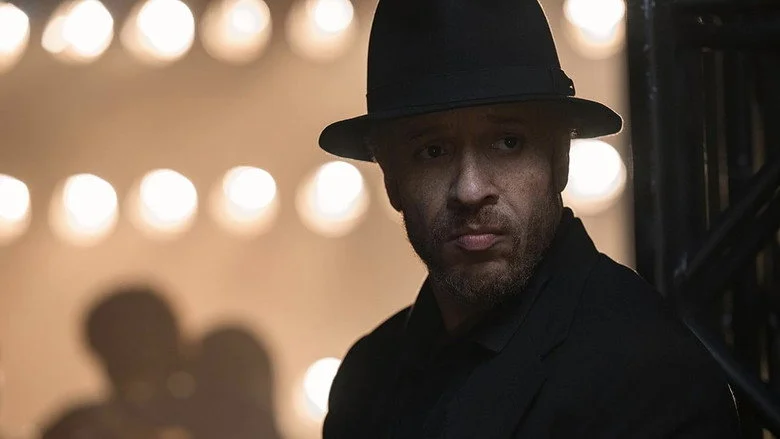
Colman Domingo’s Joe Jackson: Pressure as Protagonist
Colman Domingo reframes the father figure not as a conventional villain but as the systemic pressure Michael cannot escape. Domingo plays Joe as a man who sees his son’s talent as product, not person, a distinction that anchors the film’s entire family conflict. His scenes establish the psychological weight that shapes every decision Michael makes in the first act.

Biopic Structure Under Strain: Performance Over Depth
Fuqua’s direction leans heavily into concert reconstruction and milestone moments, treating Jackson 5 performances and early solo acts as narrative turning points rather than mere entertainment padding. The recreated stage sequences carry the film’s visual energy, framing public success as the only language these characters truly speak. This approach gives the film strong set-piece momentum and a clear ascending arc.
The screenplay’s linear structure, childhood, family pressure, solo transition, early stardom, follows the expected biopic blueprint without deviation. John Logan keeps scenes focused on discipline, ambition, and industry mechanics, avoiding the psychological tangles that might complicate the upward trajectory. The film never asks what Michael wanted; it only shows what Michael achieved.
The limiting choice here reveals itself gradually: by ending before the later phases of his life, Fuqua avoids a fuller human portrait. The narrative deliberately stops at the beginning, presenting ascent as climax rather than a point on a longer continuum. Whether that serves the story or shortchanges it depends on what viewers expect from biography itself.
Fans of music-driven narratives and those seeking deeper explorations of English Drama reviews will find useful contrasts in how different filmmakers handle the life-into-legend transition.
Miles Teller’s John Branca: Business as Character
Miles Teller anchors the business side of Jackson’s rise, representing the legal and contractual apparatus that increasingly controls the artist’s life. His scenes with the Jackson family introduce a layer of professional management that complicates the simple family-versus-ambition dynamic. Teller provides the industry perspective that grounds the film’s exploration of how talent becomes commodity.
The Absence as Controversy: What the Film Refuses to Show
The film’s greatest gamble is its studied avoidance of later-life complexity and public scandal. Audience reception has split on whether this constitutes artistic restraint or evasion, some praise the focused early-career narrative, others criticize what feels like a carefully managed tribute rather than genuine biography. The film treads the narrow line between honoring an artist and avoiding accountability.
Nia Long and Jessica Sula round out the Jackson family dynamics, with Long providing the maternal stabilizing force while Sula’s La Toya Jackson adds sibling texture to the competitive family environment. Neither character moves beyond supporting function, but their presence frames Michael’s trajectory as part of a larger family pressure system.
If you’re drawn to biopics that take creative risks and reject the expected scope of a full-life narrative, this deserves a theatrical viewing, the IMAX presentation plays these concert recreations on an appropriate scale. But if you came expecting reckoning alongside rise, you’ll leave feeling the film deliberately stopped short.
Michael asks viewers to accept an origin story as complete biography, betting that early brilliance matters more than later complication, a risky position that doesn’t entirely pay off, earning it a measured 2.5 out of 5 for its refusal to truly dig beneath its own surfaces.
The film shares Fuqua’s tendency toward controlled spectacle and heroic framing with Star Wars review, where visual reconstruction becomes the central narrative device.
Both Michael and Karuppu verdict explore how institutional systems shape individual identity, though Michael opts for performance poetry while the other pursues legal scrutiny.
Ankit Jaiswal is the Chief Author, covering Indian cinema and OTT releases with honest, no-filler criticism. An SEO strategist by background, he brings a research-driven approach to film writing, cutting through hype to tell you exactly what's worth your time.